Crazy Widespread Disappearance of Wetlands around Houston
Wetlands in Buffalo Bayou Threatened Too
Aug. 3, 2015
The Army Corps of Engineers is not keeping track of whether developers are replacing tens of thousands of acres of wetlands lost to development in the Houston region as required by law.
Wetlands, according to the Environmental Protection Agency, “are part of the foundation of our nation’s water resources and are vital to the health of waterways and communities that are downstream. Wetlands feed downstream waters, trap floodwaters, recharge groundwater supplies, remove pollution, and provide fish and wildlife habitat.”
Under the federal Clean Water Act, the Corps of Engineers is charged with protecting our wetlands.
A study by the Houston Advanced Research Center (HARC), reported by the Houston Chronicle Friday, July 31, 2015, found that “more than 38,000 acres of wetlands vanished in greater Houston over the past two decades despite a federal policy that ‘no net loss’ can be caused by encroaching development.”

Wetland photo by John Jacob, director of Texas A&M University’s Coastal Watershed Program, published in the Houston Chronicle, July 31, 2015. Printed with permission of John Jacob.
What Flood Control Is Not Telling Us
“Maintenance” Road Planned Along Bulldozed Bank
June 4, 2015
Updated June 8, 2015. See below.
Updated June 7, 2015. See below.
The Harris County Flood Control District is planning to create a 12-foot wide pathway for maintenance vehicles along the graded bank of Buffalo Bayou in Memorial Park.
The maintenance road parallel to the bayou is not included in the plans to “restore” the wild banks of the bayou submitted to the Army Corps of Engineers by the flood control district.
The district revealed the plan for what it is calling a “Monitoring Access Zone” at an invitation-only meeting Tuesday, June 2, 2015. The meeting was one of a series to develop a planting plan for the $6 million “erosion control,” “bank restoration,” “water quality improvement,” “flood conveyance” project known as the Memorial Park Demonstration Project. Apparently the planting plan is not progressing well, as at the meeting the district proposed planting tall fescue, an invasive exotic almost impossible to control. Tall fescue has been the scourge of Texas prairies for several decades at least.
“Tall fescue forms a near-monoculture and is responsible for the loss of otherwise undisturbed prairie remnants throughout Texas and the Midwest,” reports one of our landscape ecologists.
Well, so much for the district’s native plant expertise and commitment to a native-only riparian forest.

This beautiful tributary extending deep into the center of Memorial Park is labelled a “gully” by the flood control district. It will be plugged. Photo by Jim Olive on March 25, 2015.
No trees, no “better than ever” riparian forest
Little is known about the previously undisclosed but long-suspected “Monitoring Access Zone.” According to a source who was at the meeting, the 12-foot wide pathway will be planted with some sort of seed mix for several years until the district is certain the “restored” banks will hold. They won’t hold, of course, so this grassy, flat “access zone” is likely to be permanent.
Which means no trees, no “better than ever” riparian forest and wildlife habitat, banks bulldozed and leveled even through the so-called “no-work zones.”
What is Federal Jurisdiction
The district explained at the meeting that it was not required to reveal the “monitoring” road to the Army Corps of Engineers because it does not impact federal waters, presumably because the road will be above the Ordinary High Mark, which is the lateral limit of federal jurisdiction.
But it will not be above the OHWM, which in a significant section of the park extends deep into the forest as part of the flood plain, a natural detention area, including swales and wetlands, all of which are under federal jurisdiction. The road and the “bankfull bench” upon which it will sit will also fill and block at least two tributaries, which also are under federal jurisdiction, although on its plans the district labels both tributaries “gullies,” thereby attempting to remove the tributaries from federal jurisdiction. (See sheets 16 and 18.) Gullies are classified as an “erosional feature” by federal law. An actual gully leading from the South Picnic Loop parking lot is oddly labeled a “tributary.” (See sheet 16.)
So far we don’t know the length of “Monitoring Access Zone,” whether it extends along the entire north bank of the project area, including private property, or whether a “Monitoring Access Zone” will also be built on the south bank of the project, land which belongs to the River Oaks Country Club.
Guess we’ll have to ask the flood control district. And object to the Corps.
What else is the flood control district not telling us?

Snowy egrets flying past another tributary adjacent to the middle meander in Memorial Park, also labeled a gully by HCFCD. The banks here will be bulldozed, and the bayou filled in and a new channel cut further south through River Oaks Country Club property. Photo by Jim Olive.
Update June 7, 2015
There is no “road” planned for maintenance vehicles on the wild banks of Buffalo Bayou targeted for “restoration” by the Harris County Flood Control District.
Jason Krahn, manager for the district’s controversial $6 million project to “improve” one of the last natural stretches of Buffalo Bayou, wrote in an email to Save Buffalo Bayou on June 5 that “there is no road proposed for the post construction monitoring activities associated with MPDP [Memorial Park Demonstration Project].”
Participants in the district’s Vegetation Advisory Workgroup for the dredging and channelizing project had been told that for several years after “restoration” there would be a grassy 12-foot wide “Monitoring Access Zone” for maintenance vehicles to access the bulldozed and reconstructed banks of what is now a perfectly healthy historic natural area in need of no monitoring or maintenance whatsoever–other than picking up the trash and mitigating runoff from trails and parking lots.
This “Monitoring Access Zone,” workgroup participants were told, would remain in place until there was no longer any need for monitoring, replanting, watering, removal of noxious invasive vegetation, or repairs to failing “stabilized” banks, etc. Presumably removal of noxious invasive vegetation would not include the tall fescue, a noxious invasive plant, described above, that the district earlier this month was contemplating planting. Responding to objections, the district reportedly has changed its mind about the tall fescue.
Krahn said that monitoring activities would take place on both the north and south banks of the bayou in the project area, which includes Memorial Park and the Hogg Bird Sanctuary on the north and the River Oaks Country Club on the south.
He also wrote that “no work zones” on the bayou were in fact “no work zones,” despite the fact that heavy equipment would be driven over the banks, according to the district’s plans. However, above the Ordinary High Water Mark these “no work zones” would not be graded into bankfull benches, wrote Krahn, because “these are portions of the project area that already have the necessary geomorphic characteristics for a sustainable, stable channel.” A bankfull bench is a flat or sloping area above the bank of a stream that slows overflowing floodwater.
Asked to clarify the “Monitoring Access Zone,” Krahn has not yet replied.
But it’s not a “road,” Krahn insisted. So we won’t call it a “road.”
How about sendero?
Updated June 8, 2015
Project Manager Jason Krahn has clarified the “monitoring access zone.” In an email to Save Buffalo Bayou Monday morning, Krahn wrote:
“To provide for the monitoring access as outlined in the Atkins report [the post-construction monitoring plan included in the revised permit application], the District is working to define the appropriate spacing for vegetation within a portion of the flood plain planting zone. A spacing of 12-foot in width is currently being considered to allow for this access, or ‘monitoring access zone’ as you’ve referenced it in your previous email correspondence.”
Update on the Plan to Bulldoze the Riparian Zone, Dredge, and Channelize Wild Buffalo Bayou

Yellow-crowned Night Heron by Frank X. Tolbert 2.
Feb. 8, 2015
The Army Corps of Engineers reports that it is continuing to supply the Harris County Flood Control District with their comments on the Flood Control District’s responses to the public comments on the district’s application for a federal permit.
Dwayne Johnson, regulatory project manager for the Galveston District office of the Corps, wrote in an email to Save Buffalo Bayou on Jan. 20, 2015, that the Corps expects to have a response and a possible new Public Notice about the permit application within thirty to sixty days. The new Public Notice would request new public comments only on the changes to the project plans made since the original Public Notice last April, said Johnson.
A federal Clean Water Act permit is required for the project because it will dredge and fill navigable waters of the United States. The Corps is responsible for that. The Texas Commission on Environmental Quality must certify that the Corps’ permit meets Texas Surface Water Quality Standards. The Environmental Protection Agency also has the authority under the Clean Water Act to overrule a federal permit, although the EPA has rarely done that.
In addition, the Houston City Council, as the governing body for Memorial Park, must give public notice, hold a hearing, and vote on whether the project is a proper use or taking of public parkland under Ch. 26 of the state Parks and Wildlife Code.
Memorial Park has some protection from the deeds establishing the park. The Hogg Family, which sold the parkland to the city at cost in the early 1920s, set up the multiple deeds so that ownership of the park reverts to their heirs if the land is used for other than park purposes. These reversionary rights have been left to the Daughters of the Republic of Texas and the Hogg Foundation for Mental Health.
Plus, the City of Houston Floodplain Management Office must issue a development permit for the project because it involves construction activity within a city floodplain.
Opponents of Bulldozing Wild Banks of Buffalo Bayou Shut Out of Meeting

Harris County constable protecting secret meeting of engineers and developers from potential disruption by overly polite defenders of Buffalo Bayou. Photo by Dave Fehling, KUHF.
Oct. 30, 2014
Nobody Was Pepper-Sprayed But Door-Holding Constables Didn’t Smile Either
The unsurprising vote was 18-1 Monday, Oct. 27, 2014, in favor of stripping the forested banks, dredging, channelizing, and rerouting the last natural stretch of Buffalo Bayou as it flows past our great Memorial Park in the middle of Houston.
The Harris County Flood Control Task Force, dominated by engineers, builders, architects, bankers, developers, and realtors, voted behind closed doors on secret ballots to spend $4 million in tax money to make our wild Buffalo Bayou a bigger drainage ditch for development of west Houston. That seems to be the gist of it. Along with helping the River Oaks Country Club shore up the banks of its currently being renovated golf course. The club, which owns half the property in the project, is contributing one-third of the $6 million cost.
Whether the experimental project will work is another question. But hey, if it washes out, it’s only beautiful public parkland and a stretch of the river that teaches us the healthy benefits of what natural rivers do.
Evelyn Merz, the Sierra Club representative, cast the lone opposing vote. Representatives of the Citizens Environmental Coalition and the Audubon Society did not attend the meeting, as far as we could tell. The representative of the League of Women Voters apparently voted in favor.
Task Force Chairman Ranney McDonough of McDonough Engineering refused to allow Merz to speak, though she tried.
“It wasn’t always like that,” recalls Frank C. Smith Jr., past chairman of the task force, who was allowed into the meeting as a guest of Merz. In the past, says Smith, the task force was more evenly balanced between development and environmental interests.
The thirty-one members of the little-known task force, founded in 1973 through the efforts of citizen activists like Smith, are appointed by the Harris County Commissioners’ Court. It is an advisory body, and the vote Monday was symbolic. A committee of the task force, appointed to “investigate” the controversial project, voted 5-1 in favor of it Oct. 15. Again, Merz was the only negative vote.
The Army Corps of Engineers is considering whether to issue a permit to the Harris County Flood Control District for the project, known officially as the Memorial Park Demonstration Project.
The Houston city council has already voted to waste $2 million on destroying an irreplaceable natural resource in the middle of the city. However, councilmembers must eventually vote on whether the test experiment (the often-failing techniques haven’t been proven to work on a river like ours) is a legal taking and use of public parkland according to state law.
So let your city council representatives know what you think about that.
Listen to Dave Fehling’s report on the meeting on KUHF 88.7.
Update on Our Campaign to Save the Last Natural Stretch of Buffalo Bayou in Houston
Oct. 5, 2014
Where are we now and what should you do?
The Harris County Flood Control District has applied for a permit to bulldoze most of the riparian forest and vegetation along both banks of more a mile of the last remaining stretch of natural Buffalo Bayou in the city. This is our bayou as it passes by Memorial Park. Also targeted are the tributary and high bluffs of the Hogg Bird Sanctuary, as well as other ancient cliffs and prehistoric sandstone used in the past as water crossings by buffalo and people. The project would excavate, fill, grade, and artificially rebuild the banks; dredge, deepen, and reroute the bayou channel, damming tributaries. Hundreds of trees will be cut down, many of them riparian species too small or too young to be counted by the district’s inappropriate tree survey. The shading tree canopy will be removed (project proponents claim there is no tree canopy!); the water temperature increased. The soil, packed with protective, binding roots small and large, will be dug up, tossed around, and compacted by heavy equipment. Wetlands and lovely sandy beaches will be obliterated along with the colonizing and stabilizing plants that have taken root there, a crucial stage of the natural process of building the riparian buffer so important to water quality, flood and erosion control.
All of this and more violates best management practices for riparian zones. It will destroy the bayou’s ecosystem. And this is a project developed and promoted by the Bayou Preservation Association, supported by the Memorial Park Conservancy.
Timelines Are Difficult to Predict — Updated Oct. 30, 2014
The Harris County Flood Control District has responded to the public comments sent to the Army Corps of Engineers during the public comment period, which ended June 30. The district has posted its responses on its website, and you can read them here. (Caution: big pdf.)

The River Oaks Country Club, which owns the entire south bank of the bayou project, has killed the grass on its golf course, along with some vegetation on the high banks, in preparation for redoing the golf course. Photo on Sept. 20, 2014, by Jim Olive.
The Bad Things That Happen When You Strip Forest from the Banks of Bayous
Aug. 2, 2014
We Have Forgotten The Wisdom of Our Predecessors
The early settlers knew better than to cut down the trees and vegetation from the banks of Buffalo Bayou and other streams.

Erosion control by cutting trees and vegetation and disturbing soil along the banks of Buffalo Bayou as it passes by the Houston Country Club.
Even where they set up sawmills along the bayou in the 1820s and ’30s, the mill owners had the common sense to leave the trees standing along the riverbank to protect the land from erosion, says Janet Wagner, chair of the Harris County Historical Commission.
Before that, says Wagner, the indigenous people who lived and camped along the bayou left the riparian forest intact, understanding its importance for holding the banks in place, cleansing and cooling the waters, slowing storm waters, providing fish and wildlife habitat, and much more.
The Harris County Flood Control District, in a wrongheaded plan promoted by the Bayou Preservation Association and supported by the Memorial Park Conservancy and the City of Houston, is proposing to strip most of the riparian forest buffer from some of the last wild banks of Buffalo Bayou in Houston. Known as the Memorial Park Demonstration Project, the controversial $6 million project is demonstrating to landowners up and down the bayou and elsewhere exactly what they should not do to protect their property. Preservation of riparian zones along waterways is both federal and state policy, but apparently the city and the county have not yet understood that message.
Recently the flood control district announced another misguided “restoration” project to strip trees and vegetation from the banks of a tributary of Greens Bayou.
The costly experience of the Houston Country Club ought to be instructive. The club not too long ago bulldozed a significant amount of trees and vegetation from the banks of Buffalo Bayou as it passes by the club golf course in Tanglewood. This was a project designed by the engineering firm AECOM, which also designed the failing “erosion control” project in the former Archery Range in Memorial Park at Woodway. A representative of AECOM sits on the board of the Bayou Preservation Association.
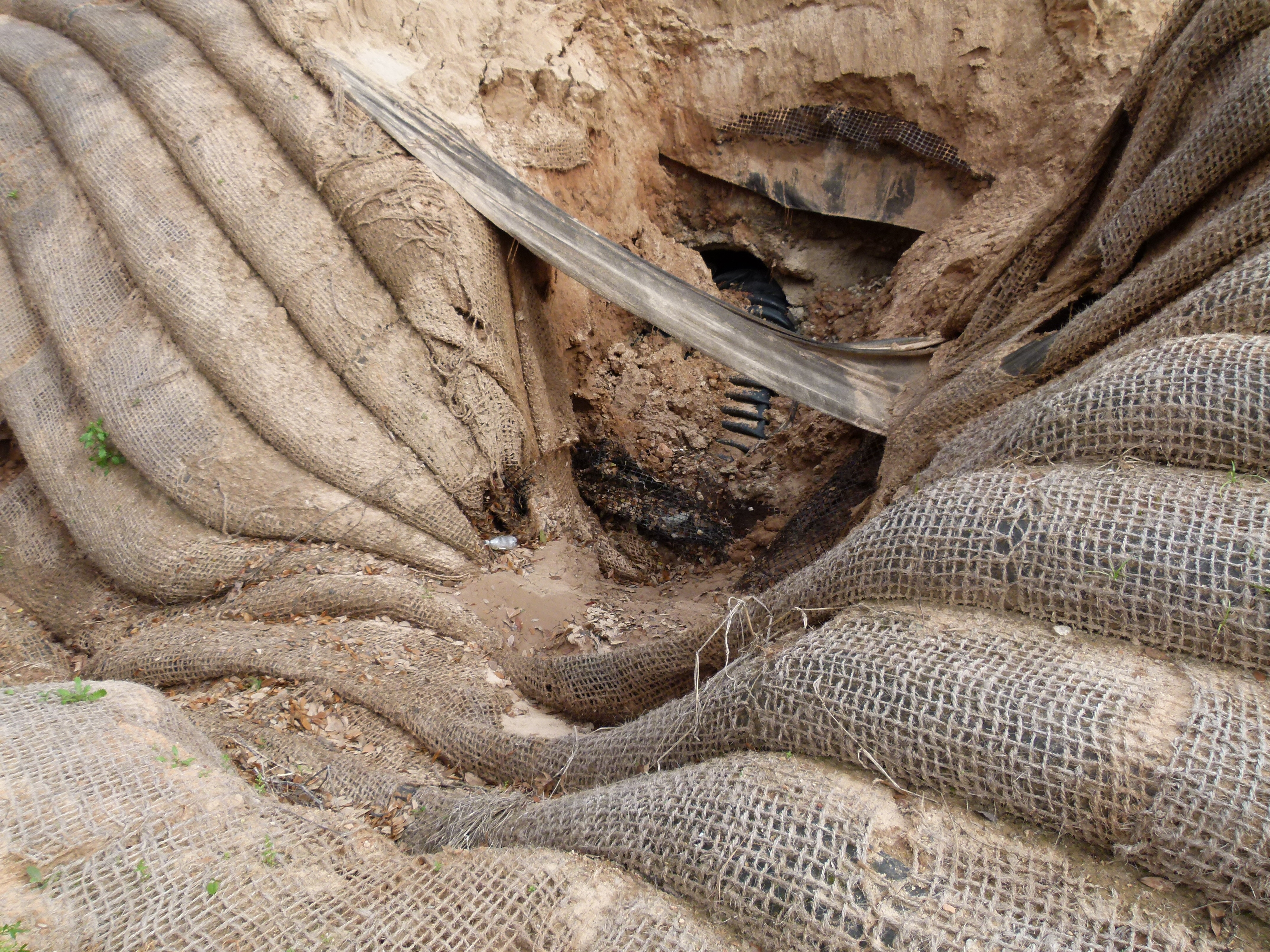
Watch this slide show of the disastrous results of razing riparian forest at the Houston Country Club. The photographs were taken on June 27, 2014, and annotated by geophysicist Richard Hyde, a longtime supporter of Buffalo Bayou.
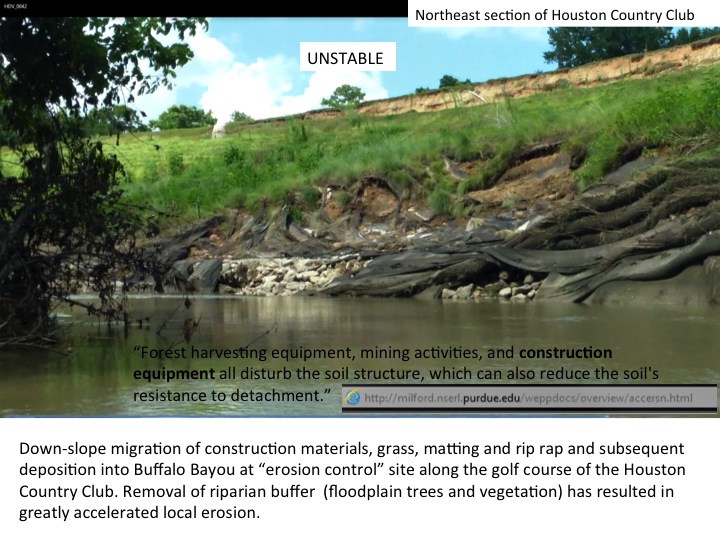
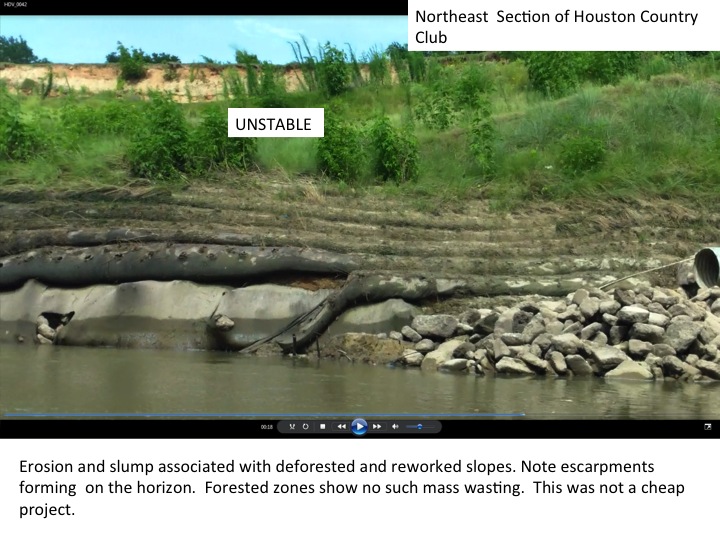
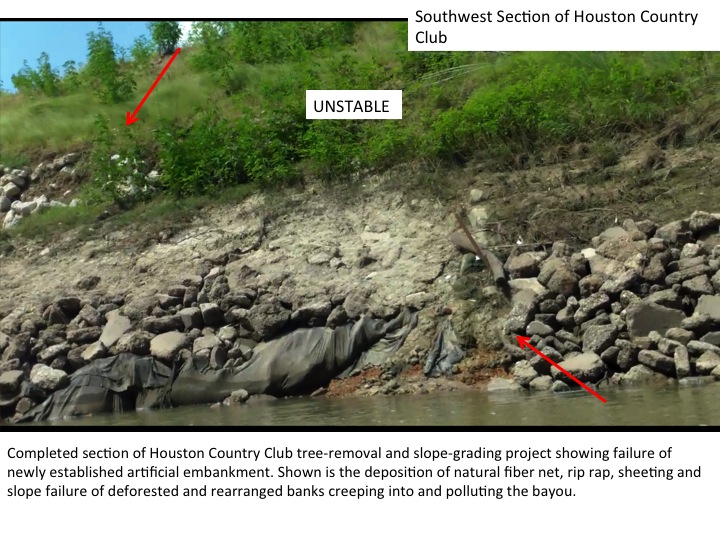
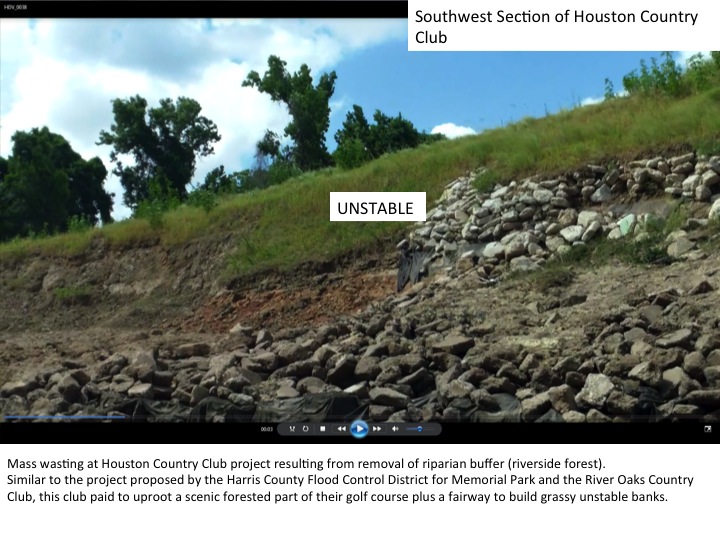

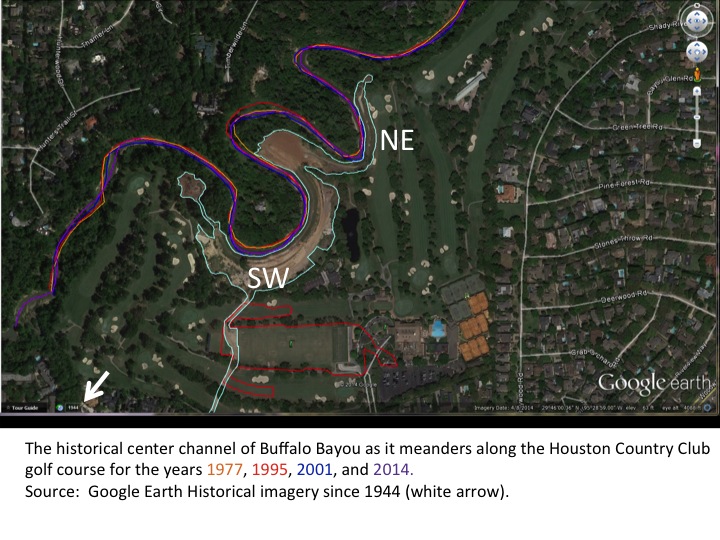
Here is another shocking slide show of photographs taken almost three months earlier on April 2, 2014, of the same, formerly forested area of the Houston Country Club. (See comparison aerial photos below.) The photos were provided by Evelyn Merz, conservation chair of the Houston Regional Group of the Sierra Club. Note in the photos shown above how much more damage had been done three months later.
The flood control district proposes to bulldoze, dredge, and trample with heavy equipment nearly 1.5 miles of Buffalo Bayou and its banks as it flows between Memorial Park and the Hogg Bird Sanctuary on the north and the River Oaks Country Club on the south. The taxpayers of Houston and Harris County are paying $4 million and the country club $2 million for this project.
The Army Corps of Engineers is currently considering whether to issue a permit for the project to the flood control district.

Buffalo Bayou before it was stripped of forest by the Houston Country Club.

Buffalo Bayou after forest was razed along parts of the Houston Country Club golf course.
Seeing What Will be Destroyed: Our Article in the Houston Chronicle
July 26, 2014
The Bayou Banks We Could Lose
Once again, a flood-control project threatens Buffalo Bayou
By Susan Chadwick for the Houston Chronicle
July 25, 2014 | Updated: July 25, 2014 3:21pm
We have pulled the canoe up to a clean, white sandy beach on Buffalo Bayou in the middle of the city. It’s still early morning, and all along our slow paddle from the bridge at Woodway great white egrets and a great blue heron fly ahead of us, leading us to our destination: the prehistoric cliffs and forested banks that could soon be obliterated by the Harris County Flood Control District.
It’s a bizarre project, all the more incomprehensible in that the project is primarily promoted by the influential Bayou Preservation Association (BPA), founded in the 1960s to prevent the flood-control district from bulldozing the natural beauty of Buffalo Bayou.
Read the rest of the article in the online edition of the Houston Chronicle. Note: This article also appeared in the print edition of the Chronicle on Sunday, August 3, 2014, Page G4.

Blue heron tracks in the mud on Buffalo Bayou. Photo by Jim Olive
A Moving Comment from Preservation Texas
July 6, 2014
The period is now closed for public comment to the Army Corps of Engineers on the application from the Harris County Flood Control District to bulldoze the wild banks of Buffalo Bayou in and around Memorial Park. The fight for the life of our beautiful southern bayou grows stronger. We must continue to raise awareness about this little known project, educate our friends and neighbors about the senseless destruction that is planned, and try to change the minds of our politicians and civic leaders. See What To Do Now.
The Army Corps received numerous comments opposing the project from experts in the field and ordinary citizens who cherish access to this unique treasure in the middle of our city. Among other things, the project violates state (pdf) and federal policy (pdf) protecting riparian buffer on our waterways.
Here is a particularly eloquent comment sent to the ACE from Preservation Texas:
June 30, 2014
Mr. Dwayne Johnson
Regulatory Branch, CESWG-PE-RB
U.S. Army Corps of Engineers
P.O. Box 1229
Galveston, Texas 77553-1229
Re: SWG-2012-01007 (Memorial Park Demonstration Project)
Dear Mr. Johnson:
We write this letter to urge denial of the permit application referenced above.
Preservation Texas included the site of the Memorial Park Demonstration Project on our 2014 Texas’ Most Endangered Places list. The scope of the project far exceeds the limited erosion problem this particular stretch of Buffalo Bayou faces. The project should be narrowed to address only portions of the Bayou that are actively eroding and in a manner that does not destroy significant vegetation, rock outcroppings, potential archaeological sites and otherwise alters the slowly, naturally evolving course of the historic waterway by cutting and filling.
A recent 14-mile paddle down the Bayou reveals that most of the erosion in the project area has been caused by the removal of trees. Coupled with increased water volumes caused by overdevelopment of areas in the Bayou’s watershed, it becomes clear that the challenges of the Bayou extend beyond the waterway itself. A radical grading and replanting project does not address root causes.
Deadline Monday, June 30, for Comments Opposing the Bulldozing of Our Beautiful, Wild Buffalo Bayou
June 29, 2014
The deadline is Monday, June 30, for the Army Corps of Engineers to receive your comments opposing a permit for Harris County to destroy nearly 1.5 miles of our wild Buffalo Bayou in and around Memorial Park, including the Hogg Bird Sanctuary. The fight for the life of our proud, southern bayou will continue, and we will prevail with your help.
However, you must let the ACE as well as all our political representatives know that you oppose this bizarre, wasteful $6 million project. Here’s how to do that. In addition you can sign the MoveOn.org petition that will be sent to the proper authorities on Monday.
The pointless, destructive project that we oppose is being dishonestly promoted as a “restoration project aimed at reducing erosion and sedimentation and improving water quality, while providing for improved aquatic resource functions,” according to the permit application from the Harris County Flood Control District. (See page 13 of the permit application. Warning: big pdf file.)
Their project will do none of those things, and the plain proof is in their own permit application.
Our Buffalo Bayou Is Not in Need of Restoration
1. The first thing to know is that the bayou here is not in need of restoration. Buffalo Bayou as it flows between Memorial Park and the Hogg Bird Sanctuary on the north and the River Oaks Country Club on the south is some of our last natural bayou and riparian wilderness remaining to the people of Houston.
This, our most beautiful reach of the bayou, long preserved as part of our public park, is in better condition than any altered stretch of the bayou, and to know why it’s important to understand what a riparian forest buffer is. A riparian forest already does everything that they claim to be the purpose of this boondoggle: it controls erosion and sedimentation, improves water quality, filters pollution, slows storm waters, etc. Every single academic and professional paper you can find emphasizes the importance of protecting riparian buffer. No true river scientist advocates bulldozing riparian buffer.
- The condition of most of the riparian buffer on the banks of our Memorial Park is rated as near-perfect, a score of 4.5 out of 5, according to the county’s own permit application. See page 450 in the permit application.
- A magnificent, very old high bluff in the Hogg Bird Sanctuary, and the lovely tributary it overlooks, have perfect riparian buffer. (Pages 533 and 557).
- Even much of the south bank owned by the country club has near perfect riparian buffer.
- Overall the riparian forest in the entire project area has a near-perfect average score of 4.5, and there will be no significant improvement from this costly project. “The overall Riparian Buffer Variable is anticipated to stay at high sub-optimal (Score 4.5) level.” (Page 452.)
- The average score of our natural riparian forest in this area is significantly reduced by the eroding lawns of a few large, private homes on the north bank and the inclusion of edges of the manicured golf course on the south bank.
The riparian forest of our public park is functioning as it should. Why should we sacrifice our beautiful, naturally functioning bayou because private homeowners stripped the riparian buffer on their property to create lawns? Why should we taxpayers pay millions to restore private property while destroying our own public property?
When They Say Restoration, They Mean Destruction
2. What do they mean by “restoration?”
Since our bayou forest is fine, in order to “restore” it, they first have to destroy it.
They will do this by bringing heavy equipment into our park and cutting access roads to the bayou through the forest. (See Map 1.) They will use the bulldozers and backhoes to strip the trees and vegetation from eighty percent of the project area (not thirty percent as claimed by the Bayou Preservation Association), regardless of its condition and including in the scenic Hogg tributary. (See Map 2.) They will scrape up the riparian sand and soil in the banks, the ancient sandstone and red clay (our geologic history) and archeological remains, and cart it away somewhere. They will dig out and cut new channels in the bayou, lay down logs and other stuff, fill in parts of the bayou, which includes more than two dozen wetlands, deface and cover up the thousands-year-old high bluffs, bring the soil and sand back, grade the banks and create new slopes, cover the new banks with fiber mats and Bermuda grass, and plant some lilies and trees.

Map 1: The dotted red lines show the 14.35 acres of riparian forest to be scraped and bulldozed. According to the HCFCD, 80 percent of the vegetation in the targeted area will be removed. Note the areas to be cleared of trees extends into the interior of Memorial Park towards the maintenance facility. This is for access by heavy equipment to the bayou. Also note the land and forest to be lost by the River Oaks Country Club on the south, and the destruction of a scenic tributary and a magnificent high bluff in the Hogg Bird Sanctuary on the north.
Why Do They Need to Bulldoze the Forest In Order to Restore It?
3. Why don’t they just plant trees and shrubs, etc. on the few bank areas where the riparian buffer is poor? Much cheaper and less complicated. The Bayou Preservation Association, which bizarrely supports this destructive project, in a four-page position paper dated June 23, 2014, says that “the pattern of storm water releases … from the Addicks and Barker Reservoirs makes the re-vegetation approach untenable.”
But doesn’t this also apply to their purported plans to re-vegetate the 80 percent of the project length that they plan to strip and recreate? Or do they plan to leave their newly “restored” banks essentially bare and shadeless?
Erosion and Sedimentation Will Not Be Reduced, and Water Quality Will Not Be Improved.
4. The HCFCD permit application claims that this small natural riparian area contributes “approximately 359 tons per year of soil erosion.” (Page 447.) That sounds like a lot, but our analysts have put that into perspective. If you spread out that entire year’s worth of soil erosion on a football field between the twenty and forty yard lines, the sediment would be only nine inches high.
The vast majority of the sediment comes from further upstream. (See page 446.) Buffalo Bayou is twenty-six miles long from the Addicks and Barker dams in Katy to the Sabine Street bridge downtown. This short but significant project area in and around our Memorial Park is our best natural, functioning bayou. It contributes only an infinitesimal amount of sediment to the waterway. There is no evidence anywhere in the application permit, no scientific studies, no explanation of how or why excavating and filling in and rechanneling the bayou reduces erosion better than the natural system already in place.
Furthermore, removal of sediment from the water has no impact on the amount of bacteria in the water. This is according to the expert analysis of Dr. George Guillen, executive director of the Environmental Institute of Houston and an associate professor of biology and environmental science at UH-Clear Lake.
But don’t listen to us. Read the HCFCD’s application permit. Page 452: Water quality will not be improved.

Map 2: Areas of the natural banks of Buffalo Bayou to be excavated and filled. Yellow is excavate. Orange is fill.
This Project to Destroy Our Beautiful Buffalo is Nothing Other than the Same Old Flood Control Project to Make Buffalo Bayou a Bigger Drainage Ditch.
“The project purpose is … improvements to the dimension, pattern, and profile allowing the stream to convey storm water and sediment loads more efficiently.” Page 2 of the permit application.
This stealth flood control project is a joint venture between Harris County, the City of Houston, and the River Oaks Country Club. Each entity is contributing $2 million to the $6 million cost of the “demonstration” project, and the Houston city council voted last June to approve and fund it. This zombie channelization plan, a “holistic” variant of proposals long opposed by the Bayou Preservation Association, was largely conceived by the board of the BPA, who must be in need of work, do-nothing preservation being too passive and non-remunerative to somebody, and is actively promoted by the BPA and the Memorial Park Conservancy despite the huge of loss of trees and wildlife habitat, and damage to the bayou and our great public park.

A Misguided Project and Waste of Public Funds
July 19, 2014
Often the best project is to let the river fix itself. — Mathias Kondolf, “Meander Bends, Landscape Preferences, and River Restoration.” p. 51
Mathias Kondolf is one of the world’s leading river scientists. He recently wrote a letter to the Army Corps of Engineers recommending that the corps deny Harris County a permit to bulldoze the wild banks of Buffalo Bayou in and around Memorial Park.
The $6 million project would remove most of the riparian buffer from nearly 1.5 miles of some of the last remaining stretch of natural bayou in our city, demonstrating to landowners up and down the bayou and elsewhere the exact wrong thing to do. By far the most beautiful and healthiest stretch of the bayou, as it flows past Memorial Park and the Hogg Bird Sanctuary this shady, slow-moving wild bayou belongs to all of us. And amazingly, it is right here in the middle of our big city.
The project, promoted by the Bayou Preservation Association and officially a project of the Harris County Flood Control District, has no scientific or any other justification, says Kondolf. He points out that even the HCFCD says in its permit application that the stream is “recovering” (from something) and questions the county’s odd claim that razing the trees and vegetation, excavating and filling in the banks, and realigning the channel would “decrease the time needed for natural recovery.”
Kondolf points out that the existing riparian habitat is of “high quality,” that the erosion rate of the banks in the target area as estimated by the county is “not really problematic,” and notes that the construction project itself would likely dump three times more sediment into the waterway than this area does in a year.
Read Mathias Kondolf’s letter to the Army Corps of Engineers.
The forested banks of Buffalo Bayou as it flows past Memorial Park, on the left, and the River Oaks Country Club, on the right. All this would be razed by the Bayou Preservation Association’s plan to “restore” the bayou. Photo taken July 13, 2014.