The Bad Things That Happen When You Strip Forest from the Banks of Bayous
Aug. 2, 2014
We Have Forgotten The Wisdom of Our Predecessors
The early settlers knew better than to cut down the trees and vegetation from the banks of Buffalo Bayou and other streams.

Erosion control by cutting trees and vegetation and disturbing soil along the banks of Buffalo Bayou as it passes by the Houston Country Club.
Even where they set up sawmills along the bayou in the 1820s and ’30s, the mill owners had the common sense to leave the trees standing along the riverbank to protect the land from erosion, says Janet Wagner, chair of the Harris County Historical Commission.
Before that, says Wagner, the indigenous people who lived and camped along the bayou left the riparian forest intact, understanding its importance for holding the banks in place, cleansing and cooling the waters, slowing storm waters, providing fish and wildlife habitat, and much more.
The Harris County Flood Control District, in a wrongheaded plan promoted by the Bayou Preservation Association and supported by the Memorial Park Conservancy and the City of Houston, is proposing to strip most of the riparian forest buffer from some of the last wild banks of Buffalo Bayou in Houston. Known as the Memorial Park Demonstration Project, the controversial $6 million project is demonstrating to landowners up and down the bayou and elsewhere exactly what they should not do to protect their property. Preservation of riparian zones along waterways is both federal and state policy, but apparently the city and the county have not yet understood that message.
Recently the flood control district announced another misguided “restoration” project to strip trees and vegetation from the banks of a tributary of Greens Bayou.
The costly experience of the Houston Country Club ought to be instructive. The club not too long ago bulldozed a significant amount of trees and vegetation from the banks of Buffalo Bayou as it passes by the club golf course in Tanglewood. This was a project designed by the engineering firm AECOM, which also designed the failing “erosion control” project in the former Archery Range in Memorial Park at Woodway. A representative of AECOM sits on the board of the Bayou Preservation Association.
Watch this slide show of the disastrous results of razing riparian forest at the Houston Country Club. The photographs were taken on June 27, 2014, and annotated by geophysicist Richard Hyde, a longtime supporter of Buffalo Bayou.
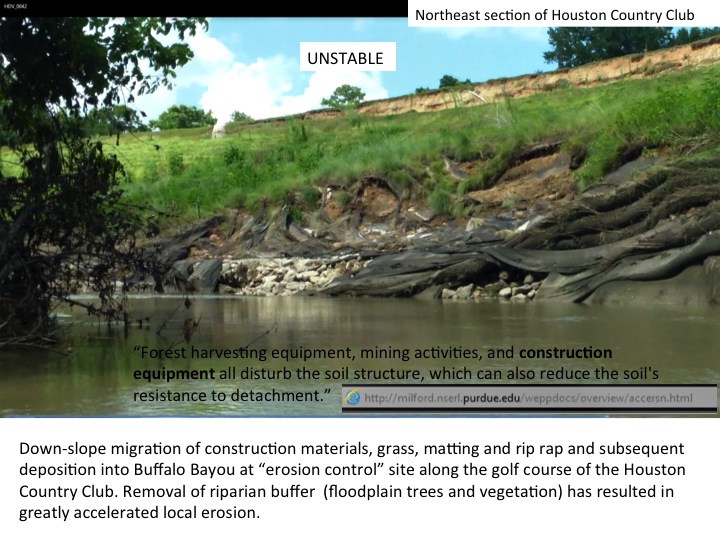
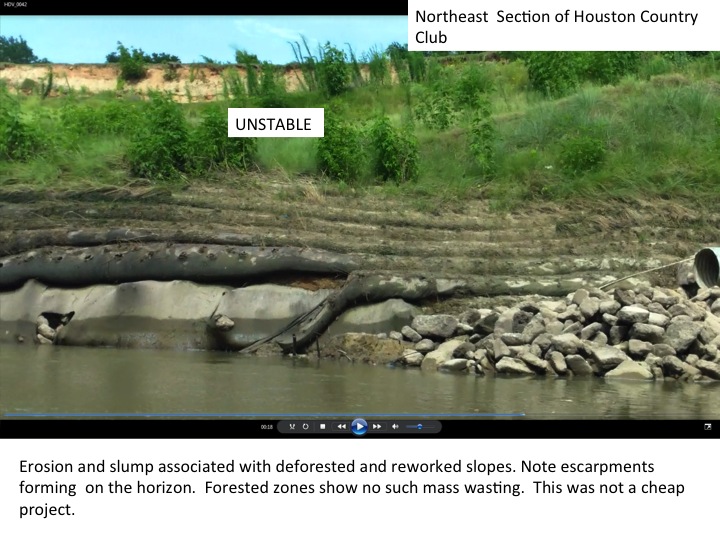
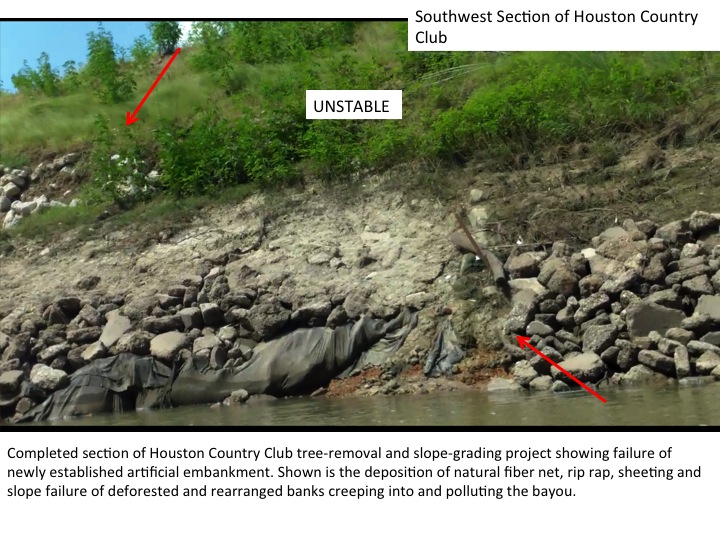
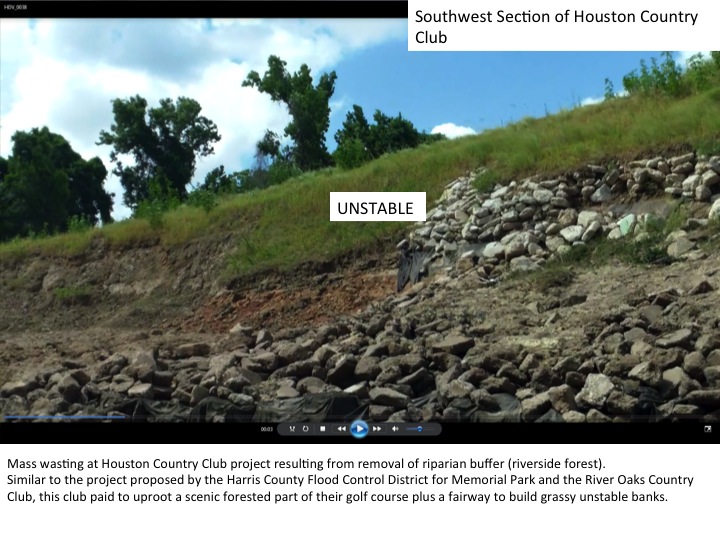

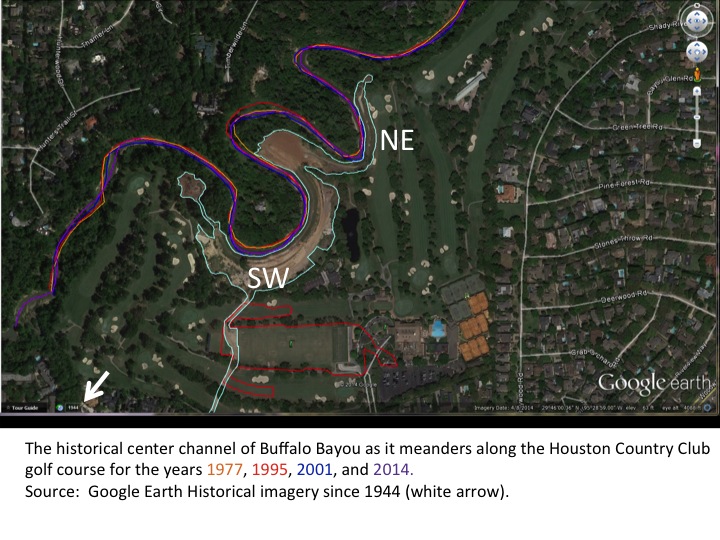
Here is another shocking slide show of photographs taken almost three months earlier on April 2, 2014, of the same, formerly forested area of the Houston Country Club. (See comparison aerial photos below.) The photos were provided by Evelyn Merz, conservation chair of the Houston Regional Group of the Sierra Club. Note in the photos shown above how much more damage had been done three months later.
The flood control district proposes to bulldoze, dredge, and trample with heavy equipment nearly 1.5 miles of Buffalo Bayou and its banks as it flows between Memorial Park and the Hogg Bird Sanctuary on the north and the River Oaks Country Club on the south. The taxpayers of Houston and Harris County are paying $4 million and the country club $2 million for this project.
The Army Corps of Engineers is currently considering whether to issue a permit for the project to the flood control district.

Buffalo Bayou before it was stripped of forest by the Houston Country Club.

Buffalo Bayou after forest was razed along parts of the Houston Country Club golf course.
Seeing What Will be Destroyed: Our Article in the Houston Chronicle
July 26, 2014
The Bayou Banks We Could Lose
Once again, a flood-control project threatens Buffalo Bayou
By Susan Chadwick for the Houston Chronicle
July 25, 2014 | Updated: July 25, 2014 3:21pm
We have pulled the canoe up to a clean, white sandy beach on Buffalo Bayou in the middle of the city. It’s still early morning, and all along our slow paddle from the bridge at Woodway great white egrets and a great blue heron fly ahead of us, leading us to our destination: the prehistoric cliffs and forested banks that could soon be obliterated by the Harris County Flood Control District.
It’s a bizarre project, all the more incomprehensible in that the project is primarily promoted by the influential Bayou Preservation Association (BPA), founded in the 1960s to prevent the flood-control district from bulldozing the natural beauty of Buffalo Bayou.
Read the rest of the article in the online edition of the Houston Chronicle. Note: This article also appeared in the print edition of the Chronicle on Sunday, August 3, 2014, Page G4.

Blue heron tracks in the mud on Buffalo Bayou. Photo by Jim Olive
Tell the Bayou Preservation Association What You Think About Its Plan to Destroy Buffalo Bayou
July 21, 2014
BPA Board Meeting Tuesday, July 22, at Noon
The Bayou Preservation Association, which is promoting the project to bulldoze Buffalo Bayou, is having a board meeting tomorrow, Tuesday, July 22, at noon. The meeting is open to the public, so go and let the BPA know what you think about its plan to raze nearly 1.5 miles of perfectly healthy riparian forest along both banks of Buffalo Bayou in and around our public Memorial Park. The meeting is in the AECOM Building, 5444 Westheimer, third floor. (Update: The BPA is a private, non-profit organization, and its meetings do not have to be open to the public.)
Do be aware that not everyone on the BPA board nor every member of the BPA supports this ugly boondoggle, which would channelize one of the last remaining stretches of natural bayou left in the city, change the course of the bayou, excavate and fill in the banks, and obliterate magnificent cliffs, lovely creeks, and tributaries. It would replace the shady, wild banks with sun-baked Bermuda grass. Wildlife habitat would be eliminated.
Note that the meeting is in the AECOM Building. AECOM, you may recall, was the engineering contractor for the failing “erosion control” project in Memorial Park at Woodway as well as for the disastrous Houston Country Club erosion control project. (Story about that coming up.)
A representative of AECOM is on the board of the BPA as well as a representative of KBR, the engineering contractor for the Buffalo Bayou project and a major donor to the BPA (along with the Harris County Flood Control District). Also on the BPA board are two property owners (Mike Garver and Terri Thomas) out of the half dozen or so private property owners whose property is to be “restored” by the $4 million taxpayer-funded portion of the $6 million HCFCD project. A major BPA donor (Michael Dishberger) is also a property owner benefiting from the public project.
BPA President Robert Rayburn works as development and natural resource director at the Energy Corridor District, which means promoting development of the Katy Prairie, which means more runoff and storm waters going into the dams and into Buffalo Bayou. The Energy Corridor District has written a letter of support for the project, citing “the importance of biotechnical drainage way stabilization and riparian restoration” [sic] and “the important role that stable, sustainable drainage corridors provide to surrounding properties …”

The BPA’s natural, sympathetic, holistic plan to help Buffalo Bayou be all it wants to be.
Another Failed Erosion Control Project on Buffalo Bayou
July 15, 2014
Kayaked down Buffalo Bayou past Memorial Park the other day with geophysicist Richard Hyde, a longtime supporter of Buffalo Bayou, an early member of the Bayou Preservation Association, and an opponent of the BPA’s very bad plan to destroy the natural beauty of Buffalo Bayou in order to … well, no one can quite figure out the purpose of this bizarre and heart-breaking project that would raze over a mile of perfectly fine riparian forest along both banks in and around our great Memorial Park. The proposal, created and promoted by the BPA and officially a project of the Harris County Flood Control District, would also dig up and fill in the bayou, its banks and high bluffs, dam up or bulldoze tributaries, causing enormous loss of land and forest to the River Oaks Country Club, which is paying $2 million for the privilege. It is a mystery why anyone thinks this is a good idea; a mystery how a project with no public benefit and so much public harm ever got funded ($4 million from county and city taxpayers); and a mystery why the BPA, an organization founded to “preserve the natural beauty” of the bayou, would be so hell-bent on eradicating it.
The water was very low — known as base flow, the bayou’s natural flow during fair weather, which is very slow and shallow. Except it wasn’t really base flow because a thunderstorm had just passed over, so even as we were slip-sliding in under the Woodway bridge the water was rising and the current picking up from runoff.
Our first shocking encounter was the new Woodway drainage outfall, recently constructed at a cost of $1,147,934 to Houston taxpayers (i.e. taxes that went to the Galleria area TIRZ 16 rather than into the city treasury). Laughably, this project, no longer under construction but still closed to the public, is described as an “erosion control” project in the TIRZ 16-Uptown 2013-2017 Capital Improvement Plan. “This drainage outflow project is to mitigate erosion in banks of Buffalo Bayou at Woodway,” says the budget description.
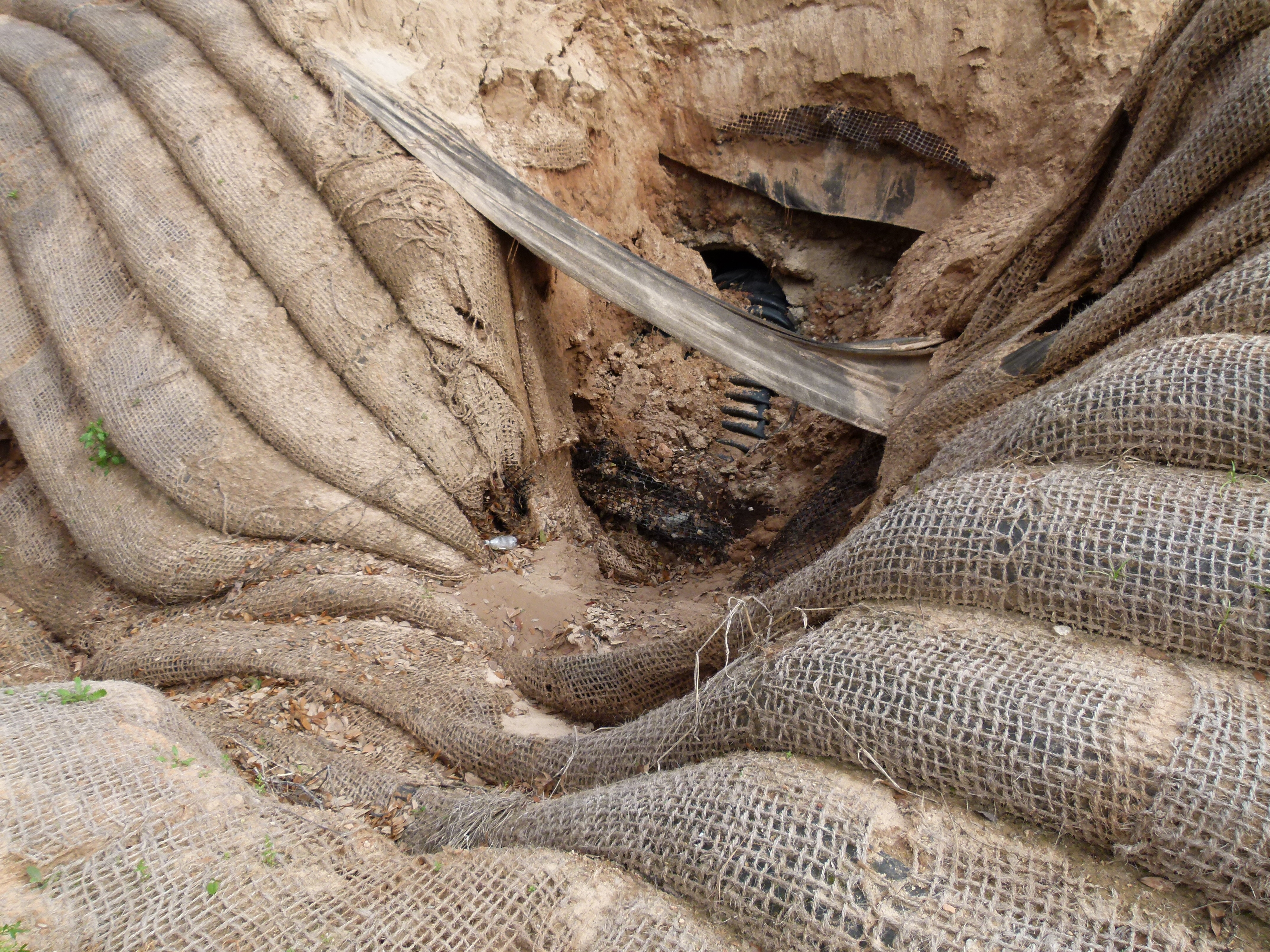
Please note the horrific erosion from the dissolving banks of this new massive outfall, the sand and mud clogging the channel, the concrete sidewalk and steps. There were trees here once, and a nature trail. Update 8.4.2014: In 1848, the rock-bottomed ford here was known as “Dutchman’s Crossing.”

Photo taken July 15, 2014, of mud and sand eroding from sides of new drainage outfall at Woodway on Buffalo Bayou.
The budget shows no funds allocated for operating and maintenance.
The big, new drainage pipe was also supposed to be set at an angle that allowed the often powerful flow of water to be released in the direction of the flow of the bayou, instead of shooting directly at the opposite bank. But apparently someone forgot to tell that to AECOM, the engineers who designed the project (as well as the tragically unsuccessful “erosion control” project at the Houston Country Club, which razed much of the riparian forest buffer on the banks of Buffalo Bayou along its golf course). AECOM designed the Woodway outfall so that the water blasts directly at the opposite bank, which is already being eaten away by the force.

The big new outfall shoots storm water directly at the opposite bank and sediment into the bayou. Oops. Maybe “erosion control” means “increasing erosion”?
Mr. Hyde just shook his head.
This “erosion control” project is in City Council Member Oliver Pennington’s district and Mr. Pennington is running for mayor, as he tells everyone he meets, so be sure to let him know what you think about Mr. Pennington’s “erosion control.” He’s holding a public meeting on Wednesday, July 30, 2014, from 6:00 to 7:30 pm at St. Anne’s Catholic Church, St. Basil’s Hall, 2140 Westheimer (at the corner of Shepherd). The meeting is to discuss “storm drainage improvements” on Shepherd from Westheimer to Buffalo Bayou. The project is scheduled to begin in a few weeks and will last over a year, so it’s very kind of Mr. Pennington to offer a public meeting about it.
Mr. Pennington supports the “erosion control” project that requires razing the wild banks and destroying our natural bayou in and around Memorial Park. So let him know what you think about that too. Might be time to bring out the pitchforks pickets and banners.
To be continued.
BPA Claims Not True. Project Is Wrong, Wrong, Wrong: Director of Cockrell Butterfly Center

Belted Kingfisher. ©Houston Audubon Society.
June 25, 2014
On Sunday (June 22) I canoed down Buffalo Bayou with a friend, from Voss to the junction with White Oak Bayou. Seeing this transect of the bayou (which included the section slated for “restoration”) has convinced me that this project is wrong, wrong, wrong on a number of levels: aesthetically, environmentally, and financially. I have heard from proponents of the plan that the erosion in this area is “significant” and that the vegetation is “largely invasive species.” Neither of these claims are true, as far as I could see. Yes, there are areas where some erosion is taking place – but this is natural on a waterway. Property owners all along the bayou have used a variety of different means (immensely less drastic and costly than what is proposed) to shore up their banks and reduce or eliminate erosion. Certainly there were a few non-native species along the banks, but the prevailing vegetation was native vines, sycamores, box elders, and other trees and shrubs native to the area. The cliffs, which would be eliminated in the proposed reconfiguration, are important habitat for nesting kingfishers (which we saw only in this stretch of the bayou). Furthermore, the stretch that borders Memorial Park is the only part of the bayou where natural habitat (and all the animals it contains) borders the watercourse.
It was an awful shock to come out to the areas that have already been modified and “improved” = where no trees overhang the bayou, where graded, grassy slopes come down to the water’s edge, and where there is no semblance of “natural” anywhere. In these areas (from Montrose and farther east) it was hot, exposed, and little wildlife was evident. These “improved” areas were stark and ugly – a human-manipulated landscape with no shade and no wildlife.
I can only imagine the expense of carrying out the proposed “improvements” – and at what environmental cost? Seems to me the River Oaks Country Club could use some of the methods already put in place by homeowners along the bayou’s banks to shore up the areas of concern – leaving the rest alone. Taxpayers should not have to pay for this drastic plan that would have catastrophic and permanent effects on the aesthetics and environmental integrity of Buffalo Bayou along this stretch.
I thoroughly oppose the proposal and hope that you, Mayor Parker and city council members, will stand up to those trying to sell this as an improvement. It is not. Please say no to this proposed “restoration” of Buffalo Bayou.
Sincerely,
Nancy Greig, PhD
Director Cockrell Butterfly Center
[Editor’s Note: the BPA is the Bayou Preservation Association, which is promoting this project to destroy the natural beauty of this healthy, functioning stretch of Buffalo Bayou in and around our public Memorial Park.]

A Misguided Project and Waste of Public Funds
July 19, 2014
Often the best project is to let the river fix itself. — Mathias Kondolf, “Meander Bends, Landscape Preferences, and River Restoration.” p. 51
Mathias Kondolf is one of the world’s leading river scientists. He recently wrote a letter to the Army Corps of Engineers recommending that the corps deny Harris County a permit to bulldoze the wild banks of Buffalo Bayou in and around Memorial Park.
The $6 million project would remove most of the riparian buffer from nearly 1.5 miles of some of the last remaining stretch of natural bayou in our city, demonstrating to landowners up and down the bayou and elsewhere the exact wrong thing to do. By far the most beautiful and healthiest stretch of the bayou, as it flows past Memorial Park and the Hogg Bird Sanctuary this shady, slow-moving wild bayou belongs to all of us. And amazingly, it is right here in the middle of our big city.
The project, promoted by the Bayou Preservation Association and officially a project of the Harris County Flood Control District, has no scientific or any other justification, says Kondolf. He points out that even the HCFCD says in its permit application that the stream is “recovering” (from something) and questions the county’s odd claim that razing the trees and vegetation, excavating and filling in the banks, and realigning the channel would “decrease the time needed for natural recovery.”
Kondolf points out that the existing riparian habitat is of “high quality,” that the erosion rate of the banks in the target area as estimated by the county is “not really problematic,” and notes that the construction project itself would likely dump three times more sediment into the waterway than this area does in a year.
Read Mathias Kondolf’s letter to the Army Corps of Engineers.
The forested banks of Buffalo Bayou as it flows past Memorial Park, on the left, and the River Oaks Country Club, on the right. All this would be razed by the Bayou Preservation Association’s plan to “restore” the bayou. Photo taken July 13, 2014.