Who’s Cutting the Black Willows on Buffalo Bayou in Memorial Park?
Dec. 21, 2014
We’ll Get to the Bottom of This Meander Mystery
Updated Dec. 24, 2014. Mystery solved! See below.
Revisiting a beautiful meander last week in Memorial Park we came across something strange. This is what we call the middle meander in the area of the Harris County Flood Control District’s project to bulldoze the riparian vegetation, dredge and channelize one of the last natural stretches of Buffalo Bayou in the middle of Houston. You can see photos taken earlier in October of this lovely spot.
This is a flat, marshy area of the north bank, filled with wildlife, mullet jumping and landing on their backs, where the bayou has gradually shifted to the east and has been naturally revegetating the sandy banks with native smartweed, ground cherry, boxelder, black willow, and sycamores.
Here is what it looked like last week.
 Wildlife tracks in the mud on the middle meander to be destroyed. Photo taken Dec. 15, 2014, by Susan Chadwick.


This area will be totally obliterated by the flood control district’s “erosion control” and “bank stabilization” project, known as the Memorial Park Demonstration Project. The bayou here will be filled in, the magnificent, very old cliffs defaced and leveled, and the bayou rerouted further to the south. Why? Because that’s what the flood control district imagines the bayou will do 200-300 years from now. So we taxpayers are paying $4 million to do all the damage now that the bayou might possibly do in several centuries.
The odd thing was that someone has been cutting down the native black willow saplings that are growing up on the sandy bench in this area, creating a new riparian forest so necessary for controlling erosion, stabilizing the banks, cleansing the water, and providing wildlife habitat. Who would do that and why?
Answer: It’s beavers.
Here’s the evidence.
 Native black willow sapling chopped, apparently by a beaver, it turns out. Experts have pointed out the tooth marks that a beaver makes. All photos taken Dec. 15, 2014, by Susan Chadwick.


Engineers Vote for More Work for Engineers on Buffalo Bayou
Developers Eager to Pave More Streets and Parking Lots
Oct. 21, 2014
Raise your hand if you ever heard of the Harris County Flood Control Task Force.

The Katy Freeway in west Houston, widest freeway in the world and major conduit of stormwater into Buffalo Bayou. Engineers voting for bulldozing Buffalo Bayou work on Interstate 10 and other highway and paving projects as well as public drainage systems.
Thought not.
Try looking on the Internet for any mention of this 31-member semi-secret committee and you’ll find almost nothing except for an occasional reference in someone’s bio and a brief note on the website of the Bayou Preservation Association. Founded in the 1970s to create “a community collaboration of engineers, developers, and interested citizens,” according to the BPA, the task force is now mostly a collaboration of engineers and developers, as is the BPA.
County Judge Bill Elliot is reported to have said at the time: “How can Harris County government adequately protect homes and businesses from the hazards of flooding and facilitate economic development, while at the same time preserving the God-given resources we have that are still in their natural state for the present and future enjoyment of our citizens?”
Last Tuesday, Oct. 15, a county task force committee looking into that question voted 5-1 in favor of spending $6 million to wreck the last natural stretch of Buffalo Bayou in Houston, a perfectly healthy 1.5 miles of wild bayou flowing in and around our Memorial Park. The project would destroy riparian forest crucial to the health of our water, to erosion and flood control. Riparian zones are increasingly being recognized as wetlands that should be federally protected for our own health and survival.
On Monday, Oct. 27, 2014, at a public meeting in the Harris County Flood Control District headquarters, 9900 Northwest Freeway, the full flood control task force will be voting on whether to go ahead with the controversial project. Update: The chairman of the task force, Ranney McDonough, said in phone call late Thursday afternoon to Save Buffalo Bayou that the doors of the meeting will be closed and the public will be turned away. But we are going anyway.
The flood control district declined to provide us with the names of the current members of the full task force, suggesting we contact the Harris County Commissioners’ Court since the commissioners’ court created and appoints the task force. No response to those emails by press time. Update: Courtesy of one of the members, we now have a reasonably current list of the members of the task force. And generally we know that of the 31 positions approved by the commissioners, about nine seats go to engineers and architects, another eight go to developers and builders, another two go to business groups, three or four go to government agencies, and another seven go to environmental or civic groups or individuals. Several positions are empty.
We will do our best to provide their contact information. These task force members need to be contacted and informed. Please let them know of your opposition and why. In addition, please note that Harris County Precinct 4 Commissioner Jack Cagle, who represents Memorial Park, is up for election on Nov. 4.
Not In. In a Meeting. On the Other Line.
As of this writing, it is unknown how many of the five task force committee members who voted in favor of the bulldozing project have seen this part of the bayou. We’ve made fruitless calls and left messages and talked to one engineer on the committee who voted in favor of bulldozing and channelizing the last wild bayou. He’d never seen the area to be destroyed; he thought there was no vegetation there.
KUHF Radio Broadcast Room Filled With Smoke from Burning Pants
Oct. 13, 2014
An Outstanding Job by Environment Reporter Dave Fehling on Buffalo Bayou and the Importance of Riparian Forest
Dave Fehling did an outstanding job of reporting for the Houston Matters radio show on the Buffalo Bayou bulldozing project that aired last Wednesday, Oct. 8, 2014. (Segment starts at 18:35.) Fehling is Houston Public Media’s State Impact reporter for Energy and the Environment.
Most importantly Fehling recognized and addressed the main issue completely ignored by the project promoters: the importance of riparian forest, which is basically wetlands necessary for cleansing our waters, controlling erosion and flooding, and providing wildlife habitat. (Yes, in addition to clean water, we need hawks and dragonflies and alligator snapping turtles to survive. We are all linked in the chain of nature.)
This project would destroy most of the perfectly healthy riparian buffer along almost 1.5 miles of the last natural stretch of our 18,000 year-old Buffalo Bayou as it flows between Memorial Park and the Hogg Bird Sanctuary on the north and the golf course of the River Oaks Country Club on the south. (The club happens to be in the process of rebuilding its entire golf course.)
Two important points that we’d like to clarify and that are causing confusion in the public mind:
- This is not a disagreement between conservationists. This is a battle between conservationists on the one side and developers and profiteers on the other. The influential Bayou Preservation Association, which was instrumental in creating this project and which continues to be its strongest advocate, is no longer a preservation group. The president of the BPA works for the Energy Corridor District, the development agency for the Katy Prairie in West Houston, one of the fastest growing areas in Houston and source of Buffalo Bayou. The BPA board is heavy with representatives of major engineering, construction, and landscape design companies. On the board is a representative of KBR, the engineering contractor for this bayou project. Representatives of the flood control district sit on the advisory board.
- This area is not suffering from severe erosion. See below.

Edible smart weed and young box elder, black willow, and sycamore building a new riparian forest on a sandy marsh of Buffalo Bayou in Memorial Park. Great white egret in the background. Photo taken on October 6, 2014, by Susan Chadwick.
Memorial Park, the Master Plan, and Our Wild Buffalo Bayou
Sept. 15, 2014
Proposals for a new master plan for Memorial Park will be presented at a public meeting on Wednesday, Sept. 17, from 6 to 8 p.m. at the Eldorado Ballroom, 2310 Elgin Street. Anyone concerned about the future of our great Memorial Park and Buffalo Bayou as it flows past the park will want to attend this meeting, one of four “update” meetings scheduled about the plan over the next several months.
The prominent national landscape architecture firm of Nelson Byrd Woltz is leading development of the plan. Thomas Woltz, principal of the firm, and his team will share results of their research and analysis, as well as initial design concepts at the Wednesday meeting co-hosted by Houston City Council Members Dwight Boykins and Robert Gallegos.
Do Nothing to Our Wild Bayou is the Best Policy
The last master plan for Memorial Park in 2004 recommended that nothing be done to disturb the natural environment of Buffalo Bayou. After extensive analysis by a team of fluvial geomorphologists and hydraulic engineers, the plan wisely concluded that “the recommended course of action for the Bayou is simply to leave it alone and consider it a symbol of dynamic natural process. The Bayou can serve as a valuable environmental education tool that depicts the change inherent in nature.”
It is not yet known, to us at least, what recommendations the new master plan will make about our treasured last stretch of wild bayou in Houston. However, contradicting the clear conclusions of the 2004 master plan, the Memorial Park Conservancy officially and actively supports the Bayou Preservation Association‘s bizarre project to bulldoze the bayou’s riparian forest, level and grade the banks and cliffs, dredge, channelize, and reroute the bayou. This would forever destroy a valuable and historic natural resource in our great public park, an amazing oasis of riverine wilderness in the middle of the city.

1915 USGS topographic map of Buffalo Bayou in the area to be bulldozed by a project supported by the Memorial Park Conservancy and the Bayou Preservation Association.
Talking to Parks and Wildlife Commissioners and Harris County Commissioner Jack Cagle

The high bluff opposite the Jones Nature Center on Spring Creek. The springs on top of this bluff are believed to be the Springs of Santa Rosa, location of villages of the tribe of Canos, an Orcoquisa tribe, one of the least known tribes of North America but mentioned by early Spanish explorers. The bluffs along Spring and Cypress creeks are part of the same Meander Belt Ridges that form bluffs along Buffalo Bayou.
Aug. 26, 2014
What We’ve Been Doing Lately in Defense of Buffalo Bayou
Last week several of us went to the annual public meeting of the Texas Parks and Wildlife Commission held in Houston this year at the Museum of Natural Science. We wanted to urge the commissioners to protect our wild Buffalo Bayou in Memorial Park and the wildlife that lives in the bayou and its riparian forest.
We found the commissioners who were present attentive, sympathetic, and even encouraging. These included the Honorable Reed Morian of Houston and the Honorable Dick Scott of Wimberley.
Two days later we visited with Harris County Commissioner Jack Cagle during a canoe trip on beautiful Spring Creek in northwest Harris County sponsored by the Bayou Land Conservancy. Commissioner Cagle, a very likable, nature-loving fellow, represents Memorial Park, the River Oaks Country Club, both in the bulldozing project area, as well as points north and west.
The Bad Things That Happen When You Strip Forest from the Banks of Bayous
Aug. 2, 2014
We Have Forgotten The Wisdom of Our Predecessors
The early settlers knew better than to cut down the trees and vegetation from the banks of Buffalo Bayou and other streams.

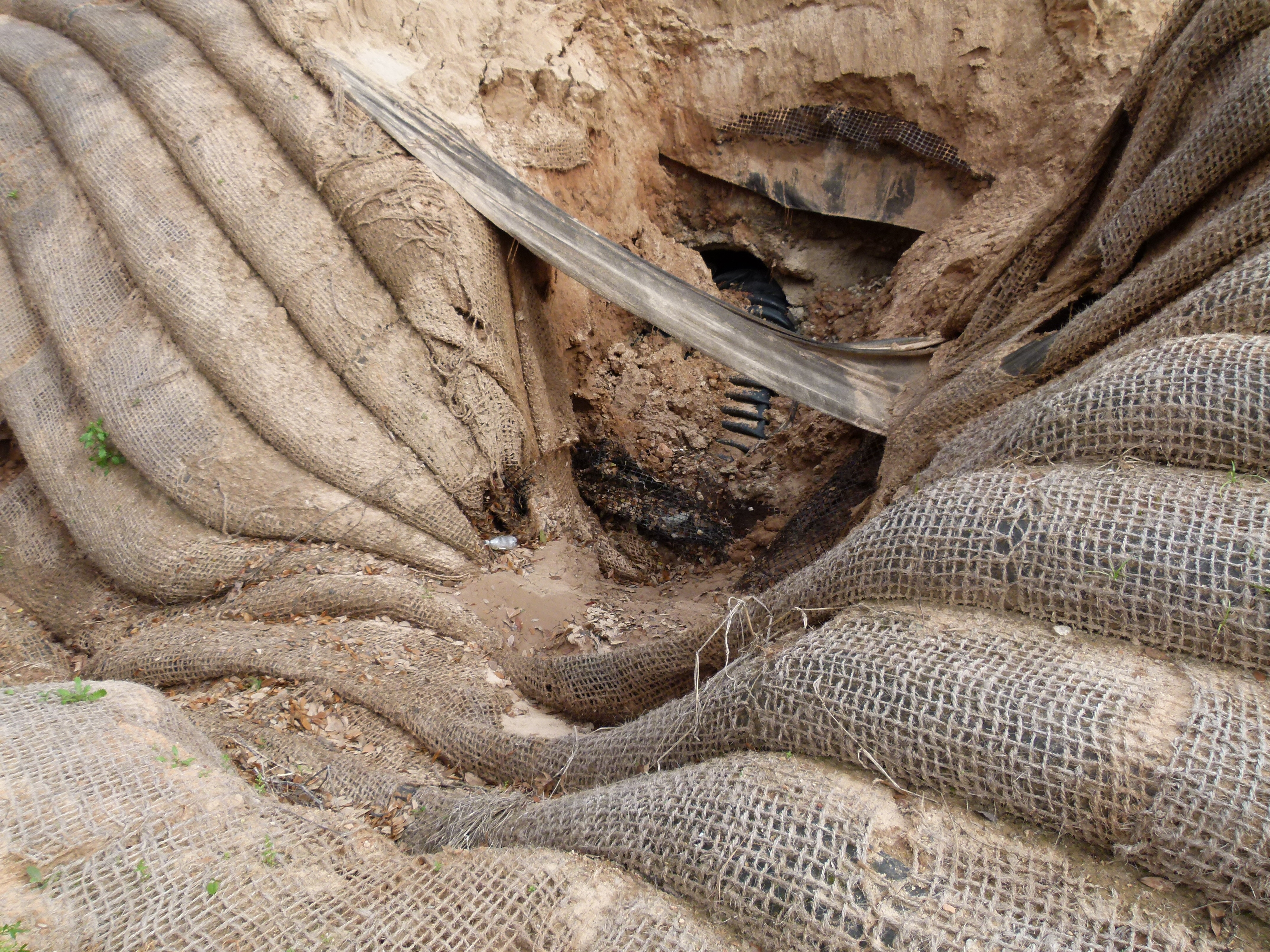
Erosion control by cutting trees and vegetation and disturbing soil along the banks of Buffalo Bayou as it passes by the Houston Country Club.
Even where they set up sawmills along the bayou in the 1820s and ’30s, the mill owners had the common sense to leave the trees standing along the riverbank to protect the land from erosion, says Janet Wagner, chair of the Harris County Historical Commission.
Before that, says Wagner, the indigenous people who lived and camped along the bayou left the riparian forest intact, understanding its importance for holding the banks in place, cleansing and cooling the waters, slowing storm waters, providing fish and wildlife habitat, and much more.
The Harris County Flood Control District, in a wrongheaded plan promoted by the Bayou Preservation Association and supported by the Memorial Park Conservancy and the City of Houston, is proposing to strip most of the riparian forest buffer from some of the last wild banks of Buffalo Bayou in Houston. Known as the Memorial Park Demonstration Project, the controversial $6 million project is demonstrating to landowners up and down the bayou and elsewhere exactly what they should not do to protect their property. Preservation of riparian zones along waterways is both federal and state policy, but apparently the city and the county have not yet understood that message.
Recently the flood control district announced another misguided “restoration” project to strip trees and vegetation from the banks of a tributary of Greens Bayou.
The costly experience of the Houston Country Club ought to be instructive. The club not too long ago bulldozed a significant amount of trees and vegetation from the banks of Buffalo Bayou as it passes by the club golf course in Tanglewood. This was a project designed by the engineering firm AECOM, which also designed the failing “erosion control” project in the former Archery Range in Memorial Park at Woodway. A representative of AECOM sits on the board of the Bayou Preservation Association.
Watch this slide show of the disastrous results of razing riparian forest at the Houston Country Club. The photographs were taken on June 27, 2014, and annotated by geophysicist Richard Hyde, a longtime supporter of Buffalo Bayou.
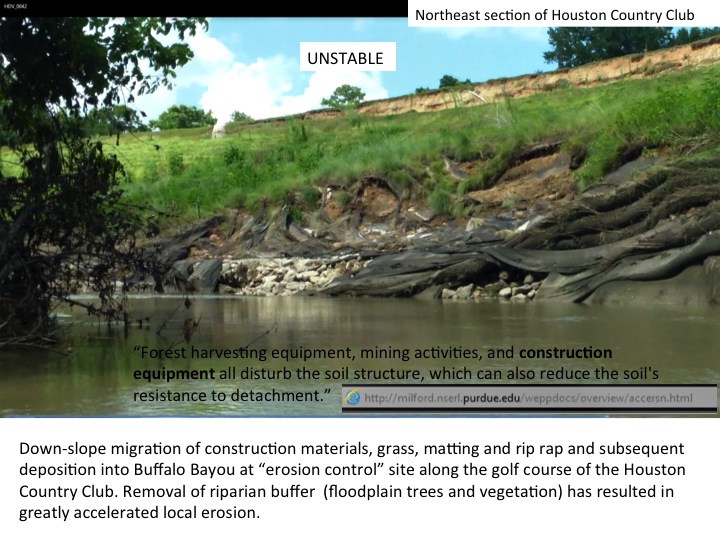
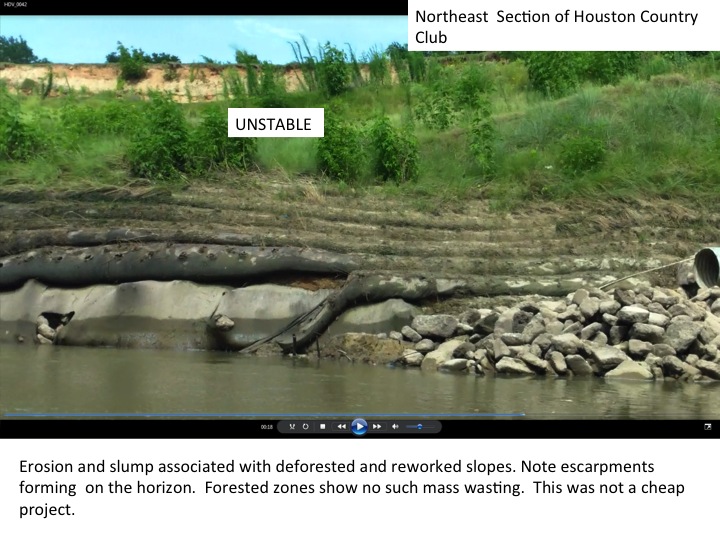
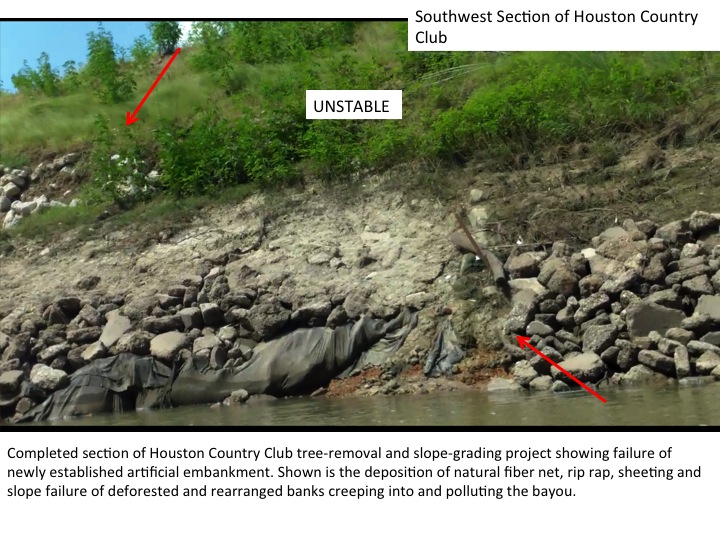
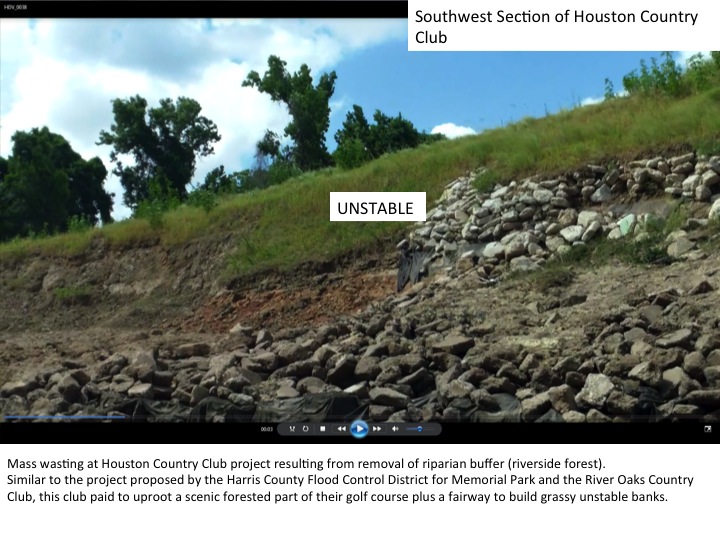

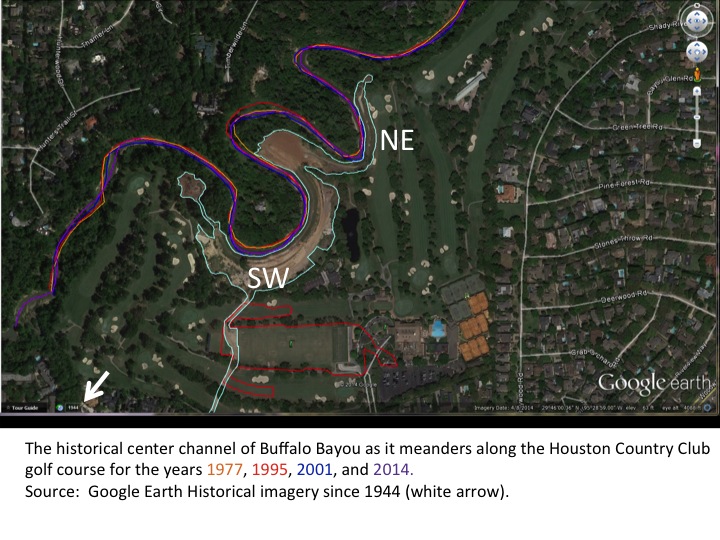
Here is another shocking slide show of photographs taken almost three months earlier on April 2, 2014, of the same, formerly forested area of the Houston Country Club. (See comparison aerial photos below.) The photos were provided by Evelyn Merz, conservation chair of the Houston Regional Group of the Sierra Club. Note in the photos shown above how much more damage had been done three months later.
The flood control district proposes to bulldoze, dredge, and trample with heavy equipment nearly 1.5 miles of Buffalo Bayou and its banks as it flows between Memorial Park and the Hogg Bird Sanctuary on the north and the River Oaks Country Club on the south. The taxpayers of Houston and Harris County are paying $4 million and the country club $2 million for this project.
The Army Corps of Engineers is currently considering whether to issue a permit for the project to the flood control district.

Buffalo Bayou before it was stripped of forest by the Houston Country Club.

Buffalo Bayou after forest was razed along parts of the Houston Country Club golf course.
Seeing What Will be Destroyed: Our Article in the Houston Chronicle
July 26, 2014
The Bayou Banks We Could Lose
Once again, a flood-control project threatens Buffalo Bayou
By Susan Chadwick for the Houston Chronicle
July 25, 2014 | Updated: July 25, 2014 3:21pm
We have pulled the canoe up to a clean, white sandy beach on Buffalo Bayou in the middle of the city. It’s still early morning, and all along our slow paddle from the bridge at Woodway great white egrets and a great blue heron fly ahead of us, leading us to our destination: the prehistoric cliffs and forested banks that could soon be obliterated by the Harris County Flood Control District.
It’s a bizarre project, all the more incomprehensible in that the project is primarily promoted by the influential Bayou Preservation Association (BPA), founded in the 1960s to prevent the flood-control district from bulldozing the natural beauty of Buffalo Bayou.
Read the rest of the article in the online edition of the Houston Chronicle. Note: This article also appeared in the print edition of the Chronicle on Sunday, August 3, 2014, Page G4.

Blue heron tracks in the mud on Buffalo Bayou. Photo by Jim Olive
Tell the Bayou Preservation Association What You Think About Its Plan to Destroy Buffalo Bayou
July 21, 2014
BPA Board Meeting Tuesday, July 22, at Noon
The Bayou Preservation Association, which is promoting the project to bulldoze Buffalo Bayou, is having a board meeting tomorrow, Tuesday, July 22, at noon. The meeting is open to the public, so go and let the BPA know what you think about its plan to raze nearly 1.5 miles of perfectly healthy riparian forest along both banks of Buffalo Bayou in and around our public Memorial Park. The meeting is in the AECOM Building, 5444 Westheimer, third floor. (Update: The BPA is a private, non-profit organization, and its meetings do not have to be open to the public.)
Do be aware that not everyone on the BPA board nor every member of the BPA supports this ugly boondoggle, which would channelize one of the last remaining stretches of natural bayou left in the city, change the course of the bayou, excavate and fill in the banks, and obliterate magnificent cliffs, lovely creeks, and tributaries. It would replace the shady, wild banks with sun-baked Bermuda grass. Wildlife habitat would be eliminated.
Note that the meeting is in the AECOM Building. AECOM, you may recall, was the engineering contractor for the failing “erosion control” project in Memorial Park at Woodway as well as for the disastrous Houston Country Club erosion control project. (Story about that coming up.)
A representative of AECOM is on the board of the BPA as well as a representative of KBR, the engineering contractor for the Buffalo Bayou project and a major donor to the BPA (along with the Harris County Flood Control District). Also on the BPA board are two property owners (Mike Garver and Terri Thomas) out of the half dozen or so private property owners whose property is to be “restored” by the $4 million taxpayer-funded portion of the $6 million HCFCD project. A major BPA donor (Michael Dishberger) is also a property owner benefiting from the public project.
BPA President Robert Rayburn works as development and natural resource director at the Energy Corridor District, which means promoting development of the Katy Prairie, which means more runoff and storm waters going into the dams and into Buffalo Bayou. The Energy Corridor District has written a letter of support for the project, citing “the importance of biotechnical drainage way stabilization and riparian restoration” [sic] and “the important role that stable, sustainable drainage corridors provide to surrounding properties …”

The BPA’s natural, sympathetic, holistic plan to help Buffalo Bayou be all it wants to be.
Another Failed Erosion Control Project on Buffalo Bayou
July 15, 2014
Kayaked down Buffalo Bayou past Memorial Park the other day with geophysicist Richard Hyde, a longtime supporter of Buffalo Bayou, an early member of the Bayou Preservation Association, and an opponent of the BPA’s very bad plan to destroy the natural beauty of Buffalo Bayou in order to … well, no one can quite figure out the purpose of this bizarre and heart-breaking project that would raze over a mile of perfectly fine riparian forest along both banks in and around our great Memorial Park. The proposal, created and promoted by the BPA and officially a project of the Harris County Flood Control District, would also dig up and fill in the bayou, its banks and high bluffs, dam up or bulldoze tributaries, causing enormous loss of land and forest to the River Oaks Country Club, which is paying $2 million for the privilege. It is a mystery why anyone thinks this is a good idea; a mystery how a project with no public benefit and so much public harm ever got funded ($4 million from county and city taxpayers); and a mystery why the BPA, an organization founded to “preserve the natural beauty” of the bayou, would be so hell-bent on eradicating it.
The water was very low — known as base flow, the bayou’s natural flow during fair weather, which is very slow and shallow. Except it wasn’t really base flow because a thunderstorm had just passed over, so even as we were slip-sliding in under the Woodway bridge the water was rising and the current picking up from runoff.
Our first shocking encounter was the new Woodway drainage outfall, recently constructed at a cost of $1,147,934 to Houston taxpayers (i.e. taxes that went to the Galleria area TIRZ 16 rather than into the city treasury). Laughably, this project, no longer under construction but still closed to the public, is described as an “erosion control” project in the TIRZ 16-Uptown 2013-2017 Capital Improvement Plan. “This drainage outflow project is to mitigate erosion in banks of Buffalo Bayou at Woodway,” says the budget description.
Please note the horrific erosion from the dissolving banks of this new massive outfall, the sand and mud clogging the channel, the concrete sidewalk and steps. There were trees here once, and a nature trail. Update 8.4.2014: In 1848, the rock-bottomed ford here was known as “Dutchman’s Crossing.”

Photo taken July 15, 2014, of mud and sand eroding from sides of new drainage outfall at Woodway on Buffalo Bayou.
The budget shows no funds allocated for operating and maintenance.
The big, new drainage pipe was also supposed to be set at an angle that allowed the often powerful flow of water to be released in the direction of the flow of the bayou, instead of shooting directly at the opposite bank. But apparently someone forgot to tell that to AECOM, the engineers who designed the project (as well as the tragically unsuccessful “erosion control” project at the Houston Country Club, which razed much of the riparian forest buffer on the banks of Buffalo Bayou along its golf course). AECOM designed the Woodway outfall so that the water blasts directly at the opposite bank, which is already being eaten away by the force.

The big new outfall shoots storm water directly at the opposite bank and sediment into the bayou. Oops. Maybe “erosion control” means “increasing erosion”?
Mr. Hyde just shook his head.
This “erosion control” project is in City Council Member Oliver Pennington’s district and Mr. Pennington is running for mayor, as he tells everyone he meets, so be sure to let him know what you think about Mr. Pennington’s “erosion control.” He’s holding a public meeting on Wednesday, July 30, 2014, from 6:00 to 7:30 pm at St. Anne’s Catholic Church, St. Basil’s Hall, 2140 Westheimer (at the corner of Shepherd). The meeting is to discuss “storm drainage improvements” on Shepherd from Westheimer to Buffalo Bayou. The project is scheduled to begin in a few weeks and will last over a year, so it’s very kind of Mr. Pennington to offer a public meeting about it.
Mr. Pennington supports the “erosion control” project that requires razing the wild banks and destroying our natural bayou in and around Memorial Park. So let him know what you think about that too. Might be time to bring out the pitchforks pickets and banners.
To be continued.

A Misguided Project and Waste of Public Funds
July 19, 2014
Often the best project is to let the river fix itself. — Mathias Kondolf, “Meander Bends, Landscape Preferences, and River Restoration.” p. 51
Mathias Kondolf is one of the world’s leading river scientists. He recently wrote a letter to the Army Corps of Engineers recommending that the corps deny Harris County a permit to bulldoze the wild banks of Buffalo Bayou in and around Memorial Park.
The $6 million project would remove most of the riparian buffer from nearly 1.5 miles of some of the last remaining stretch of natural bayou in our city, demonstrating to landowners up and down the bayou and elsewhere the exact wrong thing to do. By far the most beautiful and healthiest stretch of the bayou, as it flows past Memorial Park and the Hogg Bird Sanctuary this shady, slow-moving wild bayou belongs to all of us. And amazingly, it is right here in the middle of our big city.
The project, promoted by the Bayou Preservation Association and officially a project of the Harris County Flood Control District, has no scientific or any other justification, says Kondolf. He points out that even the HCFCD says in its permit application that the stream is “recovering” (from something) and questions the county’s odd claim that razing the trees and vegetation, excavating and filling in the banks, and realigning the channel would “decrease the time needed for natural recovery.”
Kondolf points out that the existing riparian habitat is of “high quality,” that the erosion rate of the banks in the target area as estimated by the county is “not really problematic,” and notes that the construction project itself would likely dump three times more sediment into the waterway than this area does in a year.
Read Mathias Kondolf’s letter to the Army Corps of Engineers.
The forested banks of Buffalo Bayou as it flows past Memorial Park, on the left, and the River Oaks Country Club, on the right. All this would be razed by the Bayou Preservation Association’s plan to “restore” the bayou. Photo taken July 13, 2014.