Gloves Coming Off: The BPA Has Lost Its Way on Buffalo Bayou
June 25, 2014
Our response in the Memorial Examiner to Robert Rayburn, president of the Bayou Preservation Association

Over time, the mission and purpose of citizens’ organizations can erode and change course. Tragically, this is the case with the Bayou Preservation Association, founded in 1966 “to protect the natural beauty” of Buffalo Bayou against the bulldozers of the Harris County Flood Control District.
In a 1984 KUHT documentary, BPA founding member Terry Hershey warned that we must always be vigilant because the HCFCD would always try to find a way to strip and channelize our southern, slow-moving bayou and turn it into a drainage ditch. How shocking that the BPA itself is now promoting a Harris County project to bulldoze nearly 1.5 miles of our last remaining wild bayou in the middle of Houston in order to do just that.
If we don’t destroy Buffalo Bayou now, it will “fall in on itself.”
June 12, 2014
Informative article by David Theis in the Texas Observer June 10 about the project to destroy Buffalo Bayou in order to “restore” it. Includes some wild claims by the executive director of the Memorial Park Conservancy that “the bayou is going to fall in on itself” if we don’t bulldoze it first. Yes, as difficult as it is to believe, not only does the Memorial Park Conservancy officially support this nonsensical plan to destroy the riparian forest in Memorial Park (even if all its members don’t), the organization even helped create it. It’s almost as if they think Memorial Park has too many trees or something.
Please note that the project length is 6,600 linear feet along the bayou, plus another 800 feet in a lovely tributary of the Hogg Bird Sanctuary, not 5,800 feet as reported in the article. (We know it’s hard to keep up: the Harris County Flood Control District keeps changing its plans.) However, the 18,000-year-old bayou will end up 800 feet shorter if the county and its odd allies have their way.
Also that magnificent high bluff in the bird sanctuary is not in any part a result of recent erosion, unless your time frame is several thousand years. The county plan would dig up most of that beautiful tributary you see from the top of the bluff and fill in our amazing high precipice somehow. Why? Because, erosion! Next project: the Grand Canyon.
Below is the county’s map of the riparian areas to be excavated and filled in. Yellow is “cut” and orange is “fill.”
Read the Texas Observer article.
And here is an earlier excellent article from the Texas Observer in 2002 questioning the interests of some of the movers and shakers behind the Buffalo Bayou Partnership’s development of Buffalo Bayou east of Shepherd. Some of those names are familiar. Like Mike Garver, a member of the board of the Bayou Preservation Association and a property owner on Crestwood Drive whose bayou frontage is being “restored” by the taxpayers in this project promoted by the BPA. Garver, former chairman of the Buffalo Bayou Partnership, is CEO of BRH-Garver Construction, whose major clients include, oh, look, surprise, the Harris County Flood Control District, the Army Corps of Engineers, the City of Houston, and KBR, the engineering contractor for the project.

Harris County’s 2013 map of where they plan to dig out Buffalo Bayou and fill it in. Yellow is excavate. Orange is fill in. On the south bank is the River Oaks Country Club golf course. On the north is Memorial Park, some private homes, and the Hogg Bird Sanctuary.
Save Buffalo Bayou on KPFT Progressive Forum
June 5, 2014
Listen to Evelyn Merz defend Buffalo Bayou from Harris County’s bulldozers with Progressive Forum host Wally James on KPFT. The program aired on 90.1 FM on Thursday, June 5, from 7 to 9 p.m. Merz is conservation chair of the Lone Star Chapter of the Sierra Club. Her segment starts around the 50 minute mark.

Buffalo Bayou riparian forest. Photo by Ann Stautberg.
Yes, We have Rocks in Houston. And No, That’s Not a Problem: That’s a Beautiful Pleistocene Cliff.
May 31, 2014
Floating down Buffalo Bayou past Memorial Park with only clear ground springs trickling through the fine sand and bright red clay banks. We put in last Friday morning under the Woodway Bridge, as they were spraying turf grass on the ugly drainage project that replaced the nature trail that used to exist downstream of the bridge. Led by a small white egret, with mockingbirds and cardinals calling in the trees and graceful herons crisscrossing in front of us, we floated with Memorial Park on our left all the way to the Shepherd Bridge.
This is a short video of the riparian forest the Harris County Flood Control District plans to destroy so that they can “restore” it.
What you can see when they are not flushing the 18,000-year-old mother bayou with sediment-laden water from the failing Addicks and Barker dams is: rocks. Yes, we do have rocks in Houston. Beautiful gray stone tables and ledges, huge slabs of ancient flat sandstone, mostly broken, alas, in a purposeful, barbaric act of destruction by the Harris County Flood Control District. Some years ago they drove a huge-wheeled crushing machine down the banks. Why? Who knows? Maybe they thought breaking up gajillion-years-old stone slabs would slow the water. Maybe they just don’t respect the bayou or our natural history.
But enjoy while you can the intricate, woven roots of boxelders, towering sycamores, and willows holding the historic banks together; the sparkling, natural springs surrounded by tiny green liverwort, seeping out of the layered red clay.
And regard the high Pleistocene cliffs we have here on the prairie. And no, that hard-packed cliff is not about to collapse or fall in the water. That’s what nature looks like, ladies and gents. According to the people who know this bayou well, that old cliff has been there like that for more than forty-five years, or maybe thousands.
See for yourself. This video is just under eight minutes long. If you want to watch a longer, fifteen-minute movie with informative dialog and text, you can find it here. Watch both!

Red clay bank and riparian forest on Buffalo Bayou. Memorial Park on the left.
A Good, Lively Meeting
May 26, 2014
We had a good, lively, informative meeting on Thursday, May 22, about Harris County’s plan to bulldoze 14.35 acres or almost 1.5 miles of riparian forest on both banks of Buffalo Bayou as it flows past Memorial Park, the River Oaks Country Club, and the Hogg Bird Sanctuary. Around 200 people attended, including Harris County Flood Control District Director Mike Talbott, who was accompanied by his communications manager, Kim Jackson. It was a diverse crowd in St. Stephen’s Pecore Hall and included worried residents who live along the north bank of the bayou between the bird sanctuary and the 1,500-acre public park. Also birdwatchers, tree huggers, lawyers, engineers, academics, mountain bikers and poets, landscape architects and urban planners, a uniformed employee of the Texas Parks and Wildlife Department, and people from across the political spectrum. This is an issue that is drawing passionate support from conservatives and liberals and people who are neither or some of both
As one conservative activist has commented: “If there is anything that upsets me more than destroying the environment, it’s doing it with taxpayer money.”
Mr. Talbott was called to take the mic when a member of the audience asked the question that is perplexing many people: Why? What is the point of this hugely destructive project?

The dotted red lines show the 14.35 acres of riparian forest to be scraped and bulldozed. According to the HCFCD, 80 percent of the vegetation in the targeted area will be removed. Note the areas to be cleared of trees extends into the interior of Memorial Park towards the maintenance facility. This is for access by heavy equipment to the bayou.
Defense Team on KPFT Tuesday, May 20, 3-4 p.m.
May 19, 2014
Members of the Save Buffalo Bayou defensive team will be on the Eco-Ology radio show on KPFT Tuesday, May 20, from 3 to 4 p.m. Listen to Olive Hershey, Brandt Mannchen, and Frank Salzhandler talk about why bulldozing the riparian forest on both banks of Buffalo Bayou as it flows through our historic Memorial Park and the Hogg Bird Sanctuary is an appalling idea.
Hershey is a poet, novelist, and environmental activist. Mannchen is a biologist and chair of the Forestry Committee of the Houston Sierra Club. Salzhandler is a former All-American UT swimmer, rabble rouser, director of the Endangered Species Media Project and chair of the Natural Heritage Program for the Harris County Historical Commission.
Houston Chronicle Outlook Editorial: Plan Could Ruin Buffalo Bayou
Invasive Erosion Control Plan Could Destroy Buffalo Bayou
Memorial Park plan would reduce unique waterway to a ditch
Reprinted from The Houston Chronicle.
By Olive Hershey and Frank Salzhandler, Houston Chronicle OUTLOOK, May 18, 2014 Section B
A Harris County plan to alter Buffalo Bayou as it runs through our publicly owned Memorial Park would destroy one of the last remaining river forests in Houston, an ecologically important riparian wilderness that cannot be replaced.
The county intends to bulldoze both sides of the bayou – up to 100 feet from the water’s edge in places and including a tributary in the Hogg Bird Sanctuary – stripping wide swathes of native trees, vines and undergrowth from the bayou’s natural sandy banks.
Vital habitat for hundreds of species of birds, animals and water creatures will be lost. The slow-moving bayou’s shady banks will be denuded and replanted as a sun-baked lawn.
This is their plan for Buffalo Bayou.

May 7, 2014
Tell the Army Corps of Engineers you oppose the proposal to bulldoze the natural ecosystem of our last urban wilderness. You have only until June 30 to tell the government it’s better to restore the native habitat than to destroy it.
Restore. Don’t destroy.
A riparian forest cannot be replaced.
Join us to learn more at a public meeting of concerned citizens on May 22 at St. Stephen’s Community Hall, 1805 W. Alabama, beginning at 6:30 p.m.
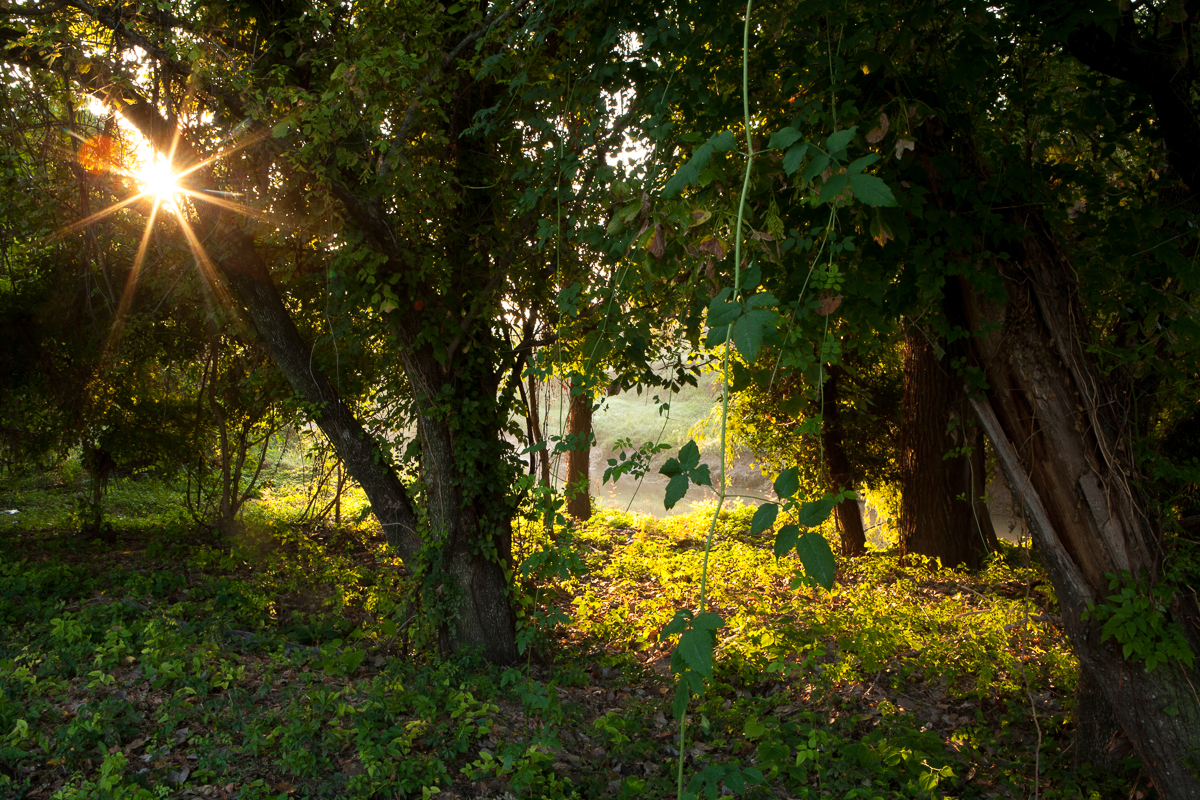
Images of Buffalo Bayou Now.
-

- Great blue heron tracks in the mud on Buffalo Bayou. Photo by Jim Olive

-

- Photo by Jim Olive

-

- Buffalo Bayou riparian forest. Photo by Jim Olive.
-

- Photo by Jim Olive

-

- Photo by G.O. Jackson Jr.
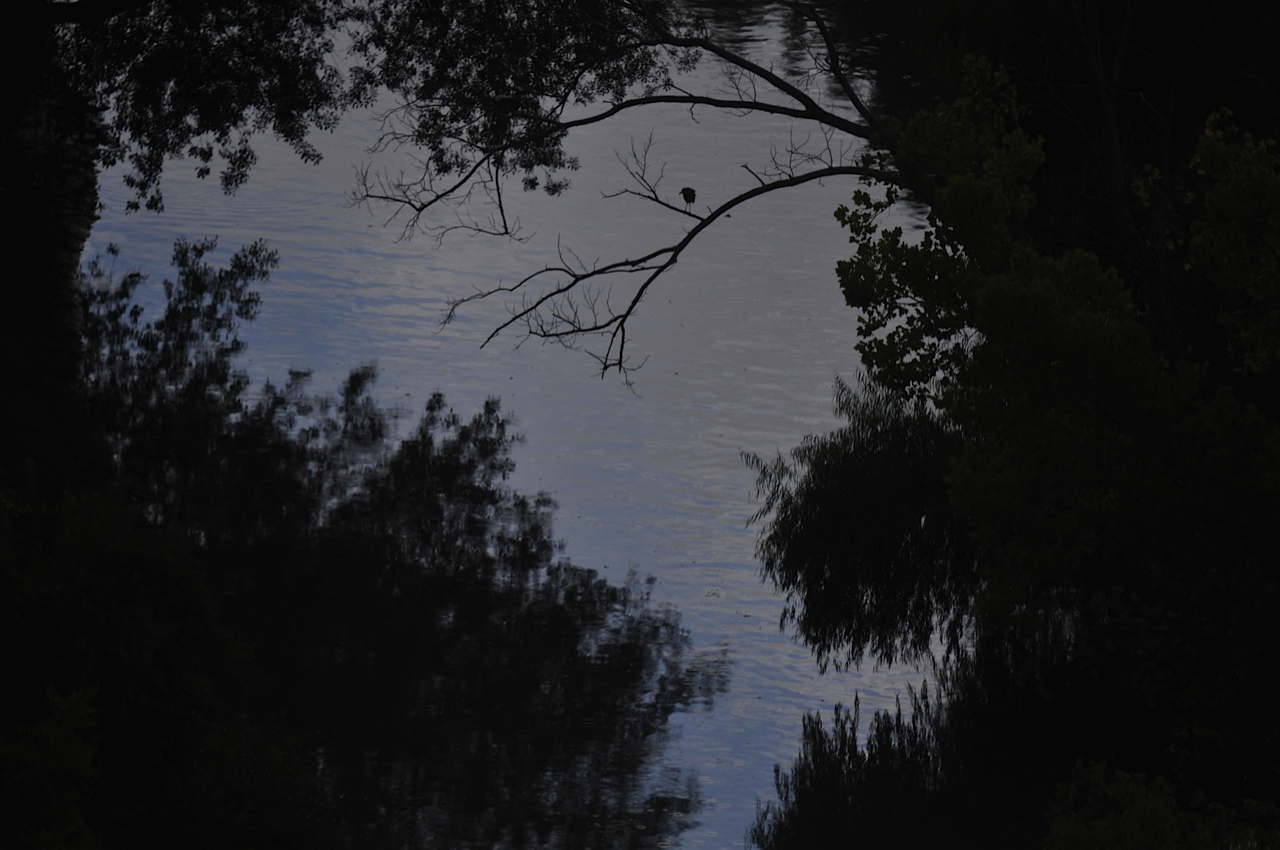
And this is what they want Buffalo Bayou to look like when they are done scraping it bare, stripping the native habitat, and planting it with grass.

A photo of Cypress Creek after “restoration” by the Harris County Flood Control District.

Deadline Monday, June 30, for Comments Opposing the Bulldozing of Our Beautiful, Wild Buffalo Bayou
June 29, 2014
The deadline is Monday, June 30, for the Army Corps of Engineers to receive your comments opposing a permit for Harris County to destroy nearly 1.5 miles of our wild Buffalo Bayou in and around Memorial Park, including the Hogg Bird Sanctuary. The fight for the life of our proud, southern bayou will continue, and we will prevail with your help.
However, you must let the ACE as well as all our political representatives know that you oppose this bizarre, wasteful $6 million project. Here’s how to do that. In addition you can sign the MoveOn.org petition that will be sent to the proper authorities on Monday.
The pointless, destructive project that we oppose is being dishonestly promoted as a “restoration project aimed at reducing erosion and sedimentation and improving water quality, while providing for improved aquatic resource functions,” according to the permit application from the Harris County Flood Control District. (See page 13 of the permit application. Warning: big pdf file.)
Their project will do none of those things, and the plain proof is in their own permit application.
Our Buffalo Bayou Is Not in Need of Restoration
1. The first thing to know is that the bayou here is not in need of restoration. Buffalo Bayou as it flows between Memorial Park and the Hogg Bird Sanctuary on the north and the River Oaks Country Club on the south is some of our last natural bayou and riparian wilderness remaining to the people of Houston.
This, our most beautiful reach of the bayou, long preserved as part of our public park, is in better condition than any altered stretch of the bayou, and to know why it’s important to understand what a riparian forest buffer is. A riparian forest already does everything that they claim to be the purpose of this boondoggle: it controls erosion and sedimentation, improves water quality, filters pollution, slows storm waters, etc. Every single academic and professional paper you can find emphasizes the importance of protecting riparian buffer. No true river scientist advocates bulldozing riparian buffer.
The riparian forest of our public park is functioning as it should. Why should we sacrifice our beautiful, naturally functioning bayou because private homeowners stripped the riparian buffer on their property to create lawns? Why should we taxpayers pay millions to restore private property while destroying our own public property?
When They Say Restoration, They Mean Destruction
2. What do they mean by “restoration?”
Since our bayou forest is fine, in order to “restore” it, they first have to destroy it.
They will do this by bringing heavy equipment into our park and cutting access roads to the bayou through the forest. (See Map 1.) They will use the bulldozers and backhoes to strip the trees and vegetation from eighty percent of the project area (not thirty percent as claimed by the Bayou Preservation Association), regardless of its condition and including in the scenic Hogg tributary. (See Map 2.) They will scrape up the riparian sand and soil in the banks, the ancient sandstone and red clay (our geologic history) and archeological remains, and cart it away somewhere. They will dig out and cut new channels in the bayou, lay down logs and other stuff, fill in parts of the bayou, which includes more than two dozen wetlands, deface and cover up the thousands-year-old high bluffs, bring the soil and sand back, grade the banks and create new slopes, cover the new banks with fiber mats and Bermuda grass, and plant some lilies and trees.
Map 1: The dotted red lines show the 14.35 acres of riparian forest to be scraped and bulldozed. According to the HCFCD, 80 percent of the vegetation in the targeted area will be removed. Note the areas to be cleared of trees extends into the interior of Memorial Park towards the maintenance facility. This is for access by heavy equipment to the bayou. Also note the land and forest to be lost by the River Oaks Country Club on the south, and the destruction of a scenic tributary and a magnificent high bluff in the Hogg Bird Sanctuary on the north.
Why Do They Need to Bulldoze the Forest In Order to Restore It?
3. Why don’t they just plant trees and shrubs, etc. on the few bank areas where the riparian buffer is poor? Much cheaper and less complicated. The Bayou Preservation Association, which bizarrely supports this destructive project, in a four-page position paper dated June 23, 2014, says that “the pattern of storm water releases … from the Addicks and Barker Reservoirs makes the re-vegetation approach untenable.”
But doesn’t this also apply to their purported plans to re-vegetate the 80 percent of the project length that they plan to strip and recreate? Or do they plan to leave their newly “restored” banks essentially bare and shadeless?
Erosion and Sedimentation Will Not Be Reduced, and Water Quality Will Not Be Improved.
4. The HCFCD permit application claims that this small natural riparian area contributes “approximately 359 tons per year of soil erosion.” (Page 447.) That sounds like a lot, but our analysts have put that into perspective. If you spread out that entire year’s worth of soil erosion on a football field between the twenty and forty yard lines, the sediment would be only nine inches high.
The vast majority of the sediment comes from further upstream. (See page 446.) Buffalo Bayou is twenty-six miles long from the Addicks and Barker dams in Katy to the Sabine Street bridge downtown. This short but significant project area in and around our Memorial Park is our best natural, functioning bayou. It contributes only an infinitesimal amount of sediment to the waterway. There is no evidence anywhere in the application permit, no scientific studies, no explanation of how or why excavating and filling in and rechanneling the bayou reduces erosion better than the natural system already in place.
Furthermore, removal of sediment from the water has no impact on the amount of bacteria in the water. This is according to the expert analysis of Dr. George Guillen, executive director of the Environmental Institute of Houston and an associate professor of biology and environmental science at UH-Clear Lake.
But don’t listen to us. Read the HCFCD’s application permit. Page 452: Water quality will not be improved.
Map 2: Areas of the natural banks of Buffalo Bayou to be excavated and filled. Yellow is excavate. Orange is fill.
This Project to Destroy Our Beautiful Buffalo is Nothing Other than the Same Old Flood Control Project to Make Buffalo Bayou a Bigger Drainage Ditch.
“The project purpose is … improvements to the dimension, pattern, and profile allowing the stream to convey storm water and sediment loads more efficiently.” Page 2 of the permit application.
This stealth flood control project is a joint venture between Harris County, the City of Houston, and the River Oaks Country Club. Each entity is contributing $2 million to the $6 million cost of the “demonstration” project, and the Houston city council voted last June to approve and fund it. This zombie channelization plan, a “holistic” variant of proposals long opposed by the Bayou Preservation Association, was largely conceived by the board of the BPA, who must be in need of work, do-nothing preservation being too passive and non-remunerative to somebody, and is actively promoted by the BPA and the Memorial Park Conservancy despite the huge of loss of trees and wildlife habitat, and damage to the bayou and our great public park.